
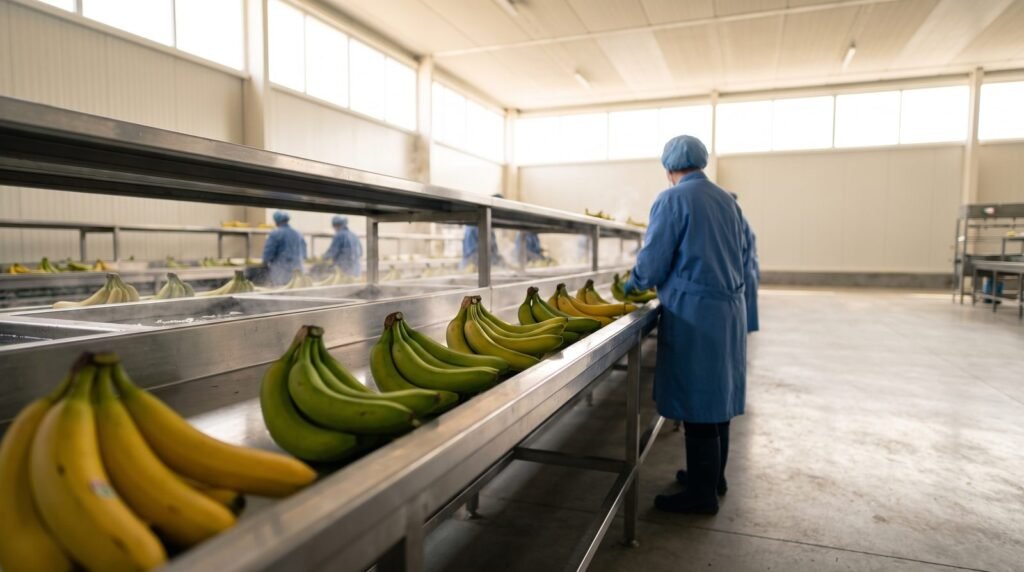
Most buyers learn how to vet a vietnamese fruit exporter the expensive way: one container arrives short, or ripe, or crowned with rot, and the questions that should have been asked in week one get asked in week nine. The useful questions are the ones with a specific answer or no answer at all. A supplier who grows and packs can name the growing area, the packhouse and the hours between cutting and cold storage. A supplier who buys on the open market and resells cannot, and answers in adjectives instead.
Seven checks below, roughly in the order they are worth doing. The first three need nothing from the supplier but a number you can look up yourself.
How to vet a vietnamese fruit exporter, in seven checks
1. Confirm the company exists, and in what form
Vietnam’s National Business Registration Portal carries a public enterprise search. Ask for the enterprise code — the same number that serves as the tax code — and look it up yourself rather than accepting a scan of a certificate.
Then check the registered name against the name that will appear on the commercial invoice and the bill of lading. A trading company invoicing for fruit that a separate packhouse produced is a normal arrangement, not a red flag. Not knowing which arrangement you are in is the problem, because it decides who you can hold to a specification.
2. Ask which growing area and which packhouse, by name
Named, not described. “Our partner farms in the south” is not an answer; a province, a district and a packhouse is. The reason to insist shows up on the day something goes wrong: a defect pattern traceable to one block of one farm gets fixed, and one that is not traceable gets repeated.
If your market is China there is a harder version of this question. Fruit entering China must come from a growing area and a packing facility registered under the relevant protocol, and the supplier should be able to give both codes without going away to check. How that system works is set out in orchard and packhouse codes for exporting bananas to China.
3. Get the residue programme, and verify the laboratory
A clean test report proves very little on its own. Three things make it mean something:
- Which analytes were tested — a short screening panel can come back clean while never looking for the active your market restricts
- Which limits were applied — your destination’s own limits, or Codex as a fallback, rather than whichever reference makes the sample pass
- Which laboratory issued it — and whether the accreditation on the letterhead is real
That last one is independently checkable. Vietnam’s Bureau of Accreditation runs the VILAS scheme for testing laboratories and publishes a searchable directory of accredited organisations. Take the accreditation number off the report and find it there. It takes two minutes and it is the cheapest check on this list.
4. Ask for numbers on the cold chain, not assurances
This is where a packer and a reseller separate most clearly, because the answers are either specific or absent. Four questions:
- How many hours from cutting to the cold room, in the dry season and in the wet?
- What pulp temperature is the fruit at when the container doors close?
- What set point, airflow and ventilation go on the reefer, and who signs that off?
- How many days of green life are being sold, and measured how?
Grading the answers does not require a technologist. Compare them against the published ranges for the commodity — for bananas, the numbers in reefer container settings for bananas. An exporter whose answers sit outside the industry ranges either knows something specific about their fruit, in which case ask what, or is guessing.
5. Ask for the last three shipments, and check one
Not references, which are easy to arrange. Ask for bill of lading numbers from three recent shipments to any market, with the commercial detail redacted. A bill of lading number can be entered on the carrier’s own tracking page, which confirms that a container moved, when, and between which ports.
What this tests is not the destination but the pattern: regular sailings on the lane being quoted, rather than one shipment eighteen months ago. A supplier who exports weekly produces these in an hour. A supplier who does not will explain why they cannot.
6. Settle inspection before settling price
Agree in writing, before the first order, who checks the fruit before loading. Three things need naming: who performs the inspection, who pays for it, and what the accept and reject criteria are — size range, colour stage at loading, and a defect list with a tolerance against each line.
A supplier who welcomes a third-party inspector into their own packhouse is telling you something real. One who prefers to self-report is also telling you something. Either way, a defect tolerance written down before loading turns an argument on arrival into arithmetic.
7. Read the payment terms as information
Terms are a risk signal as much as a cash-flow question. A request for full value in advance on a first order puts every unit of risk on the buyer, and a supplier confident in the fruit rarely needs it. A partial deposit with the balance against documents, or a letter of credit, splits the exposure in a way both sides can live with.
Read pressure as information too. Urgency about closing before an inspection is arranged, or before terms are written down, is the most reliable warning sign on this page.
The answers that should stop the conversation
- No growing area and no packhouse will be named, at any point
- A quotation well below the market with no explanation of where the difference comes from
- Certification logos in a company profile with no certificate number to check them against
- Full prepayment demanded, to a bank account in a different company’s name
- Specification questions still answered in adjectives after being asked twice
The first-order sequence itself is worth planning alongside this — documents, lead time and payment points are laid out in our buyer’s checklist for importing bananas from Vietnam.
Putting these questions to Dragon Hub
Publishing a list like this is an invitation to use it on us, which is the point. Dragon Hub packs and exports Cavendish bananas to supermarket and wholesale buyers across Asia and the Middle East, and the questions above have answers: growing area and packhouse named, hours from cutting to cold room, colour stage and pulp temperature at loading, and a third-party inspector welcome at the packhouse on terms agreed in advance. Send the specification you buy against and it gets answered line by line; the product range is the place to start.
Frequently asked questions
How can I check a Vietnamese exporter is a real registered company?
Ask for the enterprise code, which doubles as the tax code, and search it yourself on Vietnam’s National Business Registration Portal rather than relying on a scanned certificate. Then check that the registered name matches the name that will appear on the commercial invoice and the bill of lading.
Is it a problem if my supplier is a trading company rather than a grower?
Not in itself, since much of the trade works that way. The problem is not knowing. Whoever controls the packhouse controls the specification, so if your counterparty does not, establish who does and how a defect pattern gets traced back and corrected before the next sailing.
Should I ask a new supplier for audit certificates?
Ask, but verify rather than collect. A certificate is evidence only if the number can be confirmed with the body that issued it and the scope covers the site and the product being bought. A verifiable laboratory accreditation on a residue report often says more than a logo in a company profile.
What payment terms are normal on a first fruit order from Vietnam?
A partial deposit with the balance against shipping documents, or a letter of credit, are both common and split the risk. Full payment in advance on a first order concentrates all of it on the buyer, and a request for it — especially to an account in another company’s name — deserves questions before money moves.
Sources
- National Business Registration Portal, Vietnam: public enterprise search by registered company
- Bureau of Accreditation, Vietnam: the VILAS laboratory accreditation scheme and its directory of accredited organisations
