
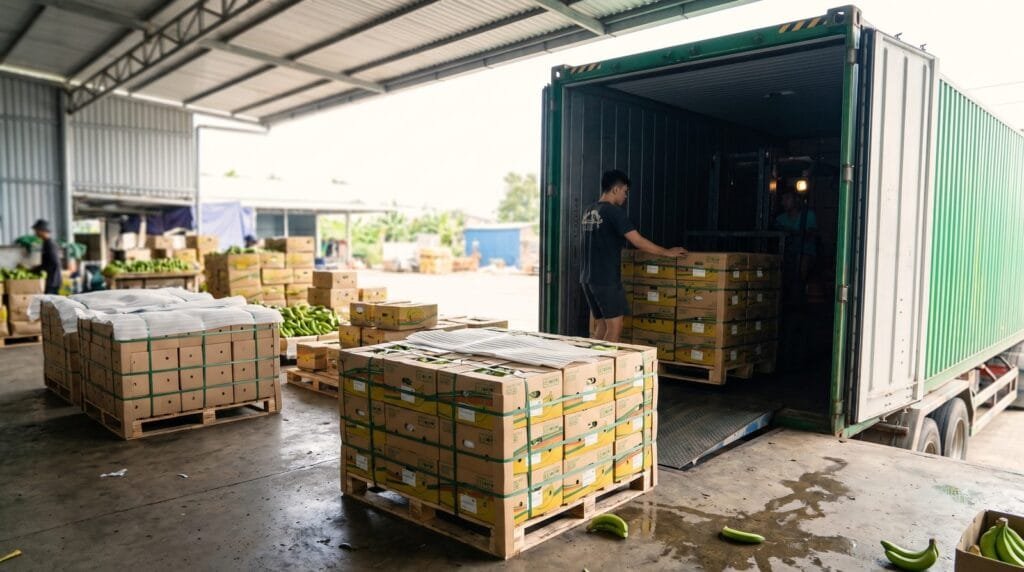
Most guides on how to import bananas from Vietnam describe the market. Very few describe the order. This one is the order: what the minimum realistically is, which documents travel with the container, which single piece of paper decides your duty rate, how long the calendar actually takes, and how the money moves.
How to import bananas from Vietnam: what you are actually buying
The practical minimum is one reefer container. Bananas are not a part-load product: the atmosphere in the box, the airflow through the stow and the cost per kilo all assume a full container, and a shared load means sharing a temperature setting with fruit that wants a different one.
The second thing to settle is which tier of the crop you are buying from. Vietnam’s banana production splits into a large lowland crop supplying China and the Middle East, and a smaller highland crop grown for the tighter tolerances of Japan and South Korea. They are priced differently because they are grown differently, and quoting one against the other is the most common reason a first quotation looks wrong.
The documents, and the one that sets your duty
A fresh banana shipment from Vietnam travels with six documents. Five are routine. One is worth real attention.
- Commercial invoice — the transaction value.
- Packing list — quantities, weights and dimensions, carton by carton.
- Bill of lading — receipt, contract of carriage and title in one document.
- Customs declaration — filed electronically on the Vietnamese side.
- Phytosanitary certificate — issued by the Vietnamese agriculture ministry, mandatory for any plant product.
- Certificate of origin — and this is the one that decides what you pay.
The certificate of origin is not a formality. Vietnam issues a different C/O form for each trade agreement, and the form you receive determines which tariff rate your customs authority applies:
| Form | Agreement | Market |
|---|---|---|
| Form E | ACFTA | China |
| Form D | ATIGA | ASEAN |
| Form AK / VK | AKFTA / VKFTA | South Korea |
| Form AJ / VJ | AJCEP / VJEPA | Japan |
| Form RCEP | RCEP | China, Korea, Japan, ASEAN |
| Form AANZ | AANZFTA | Australia, New Zealand |
| Form EUR.1 | EVFTA | European Union |
Several markets have two possible routes — Korea can be served under Form AK or Form VK, Japan under AJ or VJ, and RCEP overlaps both — and the preferential rate is not always the same. Tell your supplier which form you want before the shipment is booked. Asking afterwards means re-issuing a certificate for a container that has already sailed, which is slow and sometimes impossible.
Lead time: what the calendar really looks like
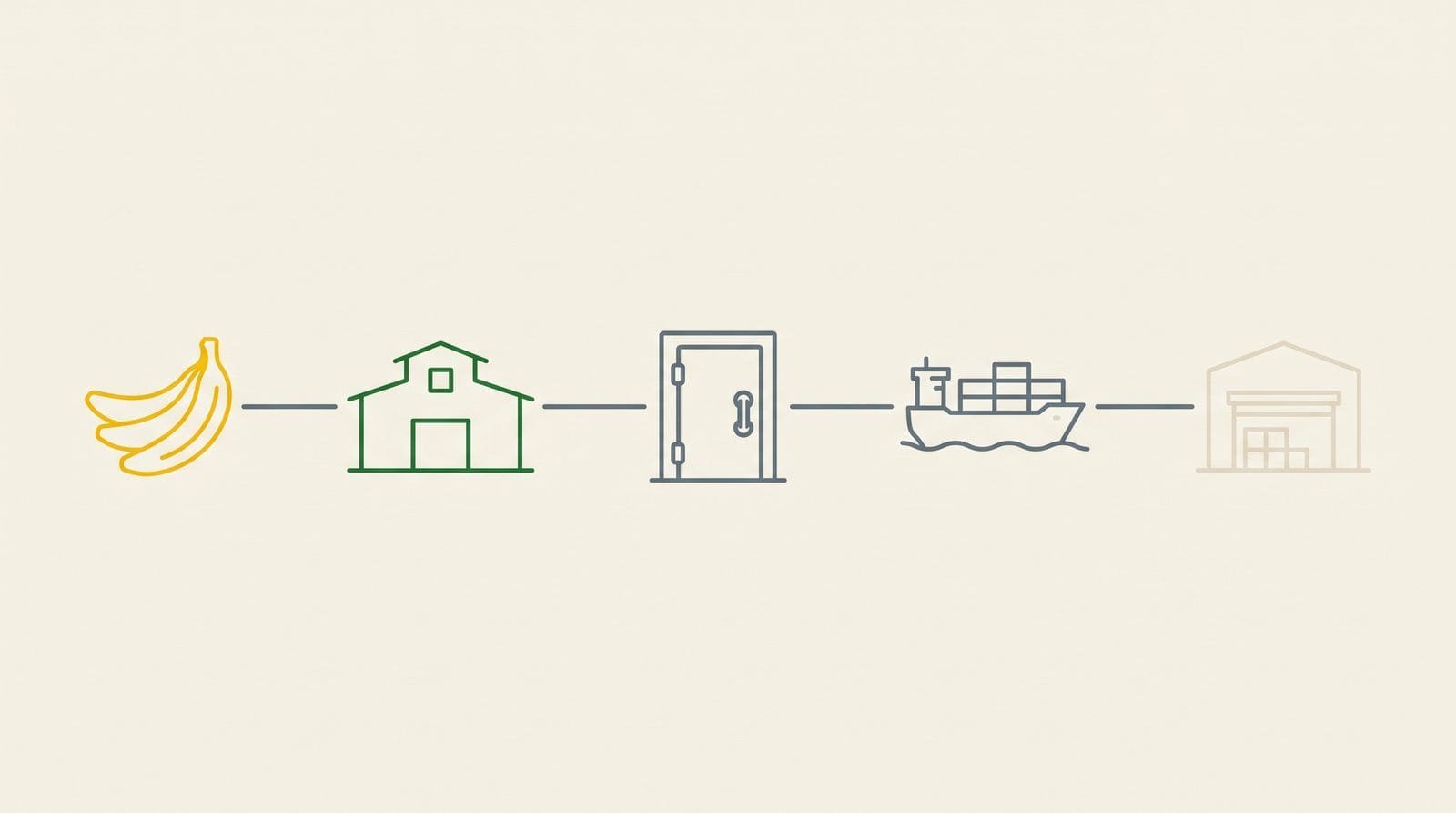
Lead time is not transit time. The honest version has four parts, and only one of them is the voyage.
- Booking and planning. Bananas are cut to order against your route, not taken from stock. The harvest is scheduled once the specification and the sailing are fixed.
- Harvest and pack. Cut, dehanded, washed and packed the same working day, then cooled without delay — a day of field heat costs roughly six days of green life.
- Voyage. Short for regional Asian lanes, longer for the Gulf and long-haul.
- Clearance and inland. The part buyers most often forget when they quote a transit time to a supplier.
What your supplier needs is the total: days from packhouse to your ripening room. That number decides the maturity the fruit is cut at, and it is the single most useful thing in a first enquiry.
How the money moves
Fresh produce is bought on instruments that assume a perishable cargo and a short cycle. In practice you are choosing between three, and each shifts risk differently:
- Telegraphic transfer — a deposit on confirmation and the balance against shipping documents. Fastest and cheapest to run, and the most dependent on the relationship.
- Letter of credit — bank-secured and standard for a first shipment with a new counterparty, but it costs fees and it is unforgiving: a document that does not match the credit exactly can hold a perishable container while the discrepancy is argued.
- Documents against payment — a middle position, common once a few containers have run cleanly.
The split between deposit and balance is negotiable and moves with volume and history. What should not be negotiable is that the terms, the incoterm and the inspection point are all agreed in the same conversation. A dispute about who owns fruit at which moment is much harder to settle after a reefer has misbehaved than before it sailed.
What to send with your first enquiry
- Destination port and market, and total days from packhouse to your ripening room
- Finger length and grade, and your defect and size tolerance in writing
- Carton weight and whether the print is yours, neutral or ours
- Volume per shipment and frequency across the year, not just the first container
- Which certificate of origin form you need
- Whether you ripen at destination, and at what colour stage you sell
- Incoterm, and your preferred payment instrument
- Any market-specific requirement — residue programme, treatment, certification, traceability codes
A supplier who is given all eight can quote in one message. A supplier who is given a volume and a country will send a price that means very little.
Working with Dragon Hub
Dragon Hub packs and exports Cavendish bananas to supermarket and wholesale buyers across Asia and the Middle East. We quote against a written specification rather than a market average, and we will tell you where we would push back before a container is booked rather than after. The full specification is on the Cavendish banana page, the rest of the range is in our product range, and if you are still drafting the spec, our guide to Cavendish banana grades and sizes lists the fields to fill in.
Frequently asked questions
What is the minimum order for importing bananas from Vietnam?
One reefer container, in practice. Bananas need a dedicated temperature setting and unobstructed airflow through the whole stow, so part-loads and mixed loads compromise both. The container is also the unit that makes the cost per kilo work.
Which documents are needed to import bananas from Vietnam?
Commercial invoice, packing list, bill of lading, Vietnamese customs declaration, phytosanitary certificate from the agriculture ministry, and a certificate of origin. The certificate of origin is the one to specify early, because the form issued determines the tariff preference you can claim.
Which certificate of origin form do I need?
It depends on your market and the agreement you claim under: Form E for China, Form D for ASEAN, Form AK or VK for South Korea, Form AJ or VJ for Japan, Form RCEP across the region, Form AANZ for Australia and New Zealand, Form EUR.1 for the EU. Confirm with your broker, then tell the supplier before booking.
How long does a banana shipment from Vietnam take?
Lead time covers booking and harvest planning, cutting and packing, the voyage, then clearance and the inland leg. Only the voyage is transit time. Give your supplier the total days from packhouse to ripening room, because that number decides the maturity the fruit is cut at.
Sources
- Certificate of origin forms for Vietnamese exports: form-by-agreement table and issuing authority
- Vietnam export document checklist: the six documents that accompany an export shipment
