
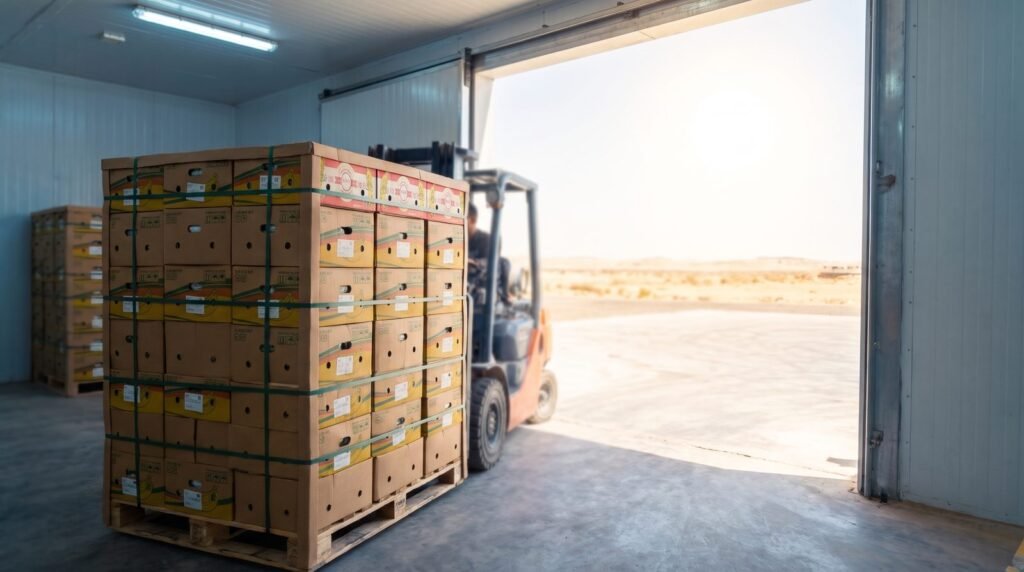
A buyer who ripens his own fruit in Dubai is solving a different problem from one doing it in Kuala Lumpur, and the difference is about twenty degrees of air. The recipe does not change: ethylene, a day or two, fifteen to twenty degrees. What changes for a ripening bananas Gulf climate importer is everything around the room — the load on the refrigeration plant, the risk in every door opening, the twenty minutes of road from the port gate.
Here are the ambient figures that drive those three, what they do to a room sized on tropical assumptions, and the decision they push back into your purchase order. If you are still deciding whether to build, our guide to the small scale banana ripening room covers the kit and the conditions.
Start with the real ambient numbers
“Very hot” is not a design input. Dubai climate normals for 1991–2020 give average daily maximum temperatures by month, and the summer figures are the ones a plant has to be sized against.
| Month | Average daily maximum, Dubai |
|---|---|
| January | 24.4 °C |
| April | 33.7 °C |
| June | 40.3 °C |
| July | 41.5 °C |
| August | 41.9 °C |
| October | 35.9 °C |
Those are averages, not peaks: the National Centre of Meteorology recorded 50.7 °C at Sweihan on 27 August 2024. For comparison, Ho Chi Minh City averages a daily maximum of about 33 °C across the year, and no month above about 35 °C.
Translate that into the number a refrigeration engineer uses. Against a room held at 15 to 20 °C, the temperature difference across the envelope in a Dubai August is roughly 22 to 27 kelvin. In southern Vietnam it is roughly 13 to 18 kelvin, so the Gulf room works against an envelope load about half again as large, for four months of the year.
What a ripening bananas Gulf climate importer is really up against
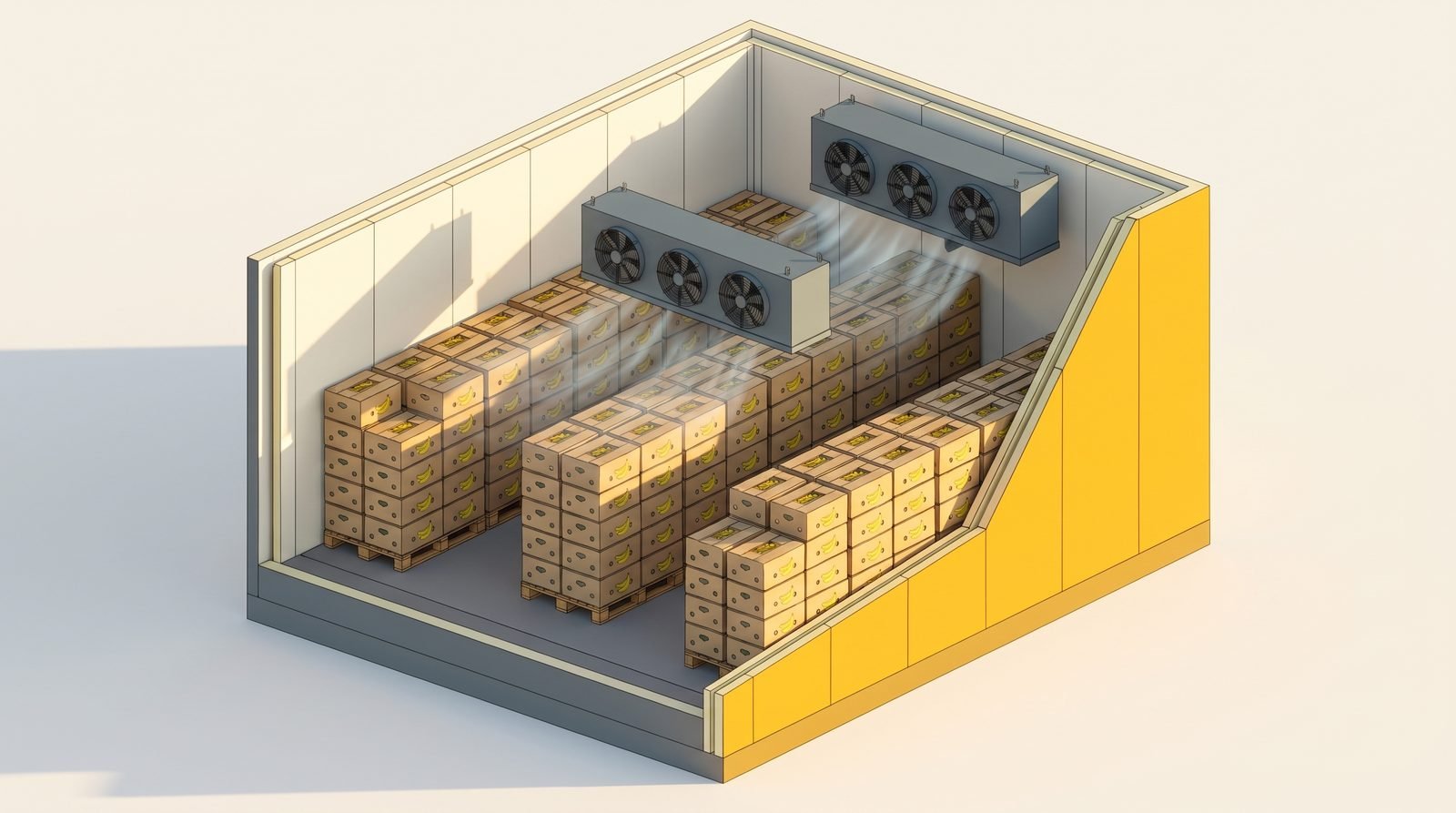
Envelope load is only the part that comes from outside. The fruit itself is the other half, and it changes behaviour the moment you gas it. Heatcraft’s refrigeration engineering manual sizes banana rooms on a pull-down load of 80 to 85 BTU per hour per box, against a holding load of approximately 44 BTU per hour per box. The fruit’s own heat output roughly doubles when it wakes up.
Stack the two together and the common failure in a converted cold room becomes obvious. The room was sized to keep fruit asleep, holds setpoint comfortably in January, and loses control in August when the doubled respiration load and the summer envelope load arrive in the same week. The symptom is not a warm room but a room that will not pull down on schedule, so the cycle runs long and one pallet finishes two colour stages ahead of another.
The same manual gives the air-side figure that gets missed: evaporators are selected at about 12.5 cfm per 41 lb box, with a temperature difference of 15 °F or less across the coil. Undersized air movement does not show up as a temperature reading. It shows up as pulp temperature mid-pallet sitting several degrees from the room reading.
The run from the port is the leg nobody budgets for
Fruit arrives at Jebel Ali at carrying temperature. What happens between the gate and the room is on you, and in a Gulf summer it is the most exposed half hour of the whole journey. University of Florida extension guidance on protecting perishables in transport is blunt about the limitation: product “should already be at or very near their desired carrying temperature” at loading, because the transport unit cannot remove field heat, and warm air infiltrates every time the doors are opened.
The same guidance names the measurement trap. Air temperatures outside the cartons change much faster than product temperatures do, so a truck whose air reading drops back to setpoint five minutes after a door closes tells you nothing useful: the cartons nearest the door hold heat the air sensor has already forgotten. In 42 °C ambient, a tail-lift transfer across an open yard is a real dose, and the only way to know what it cost is a pulp probe at the room door.
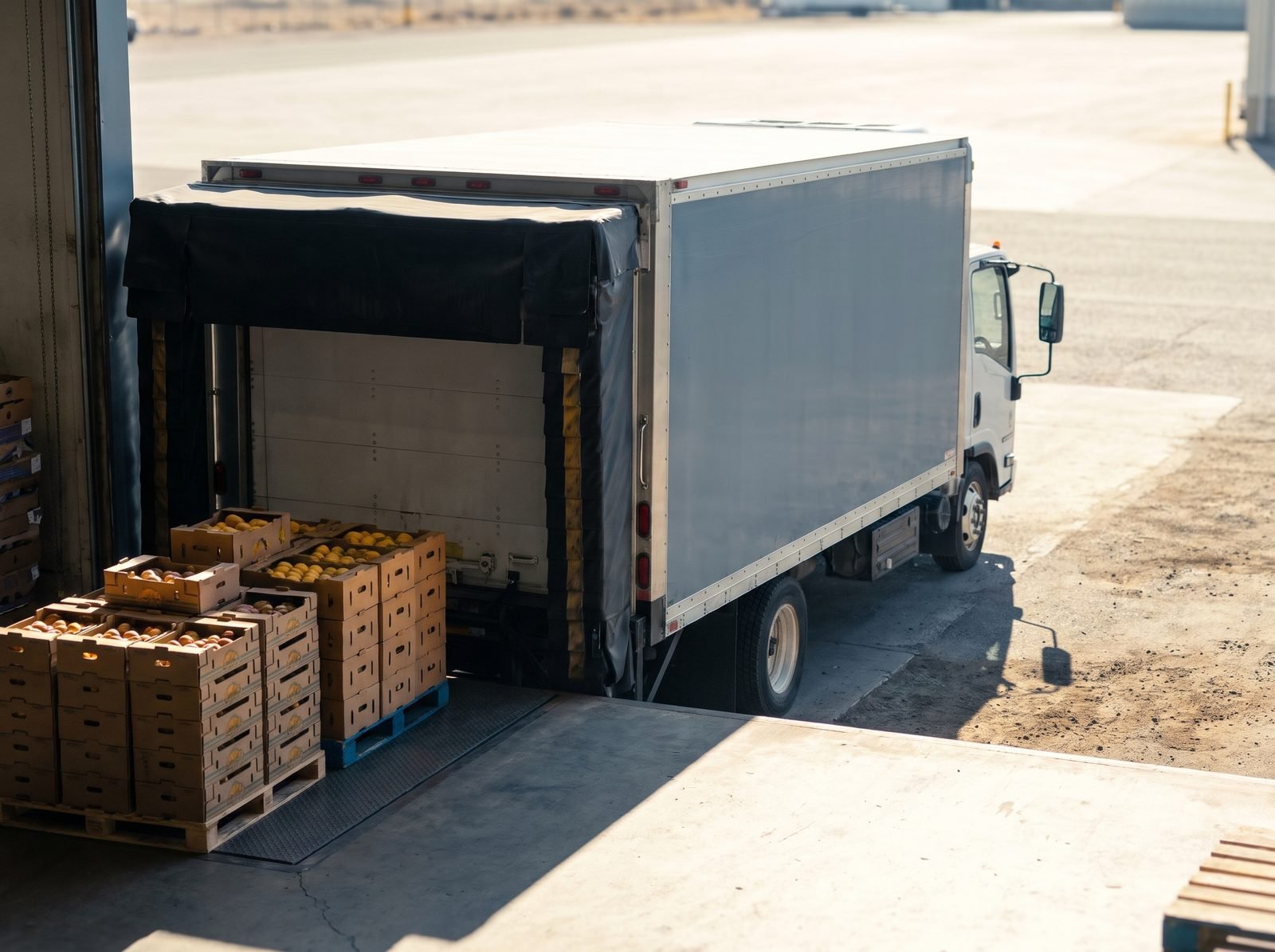
The fixes are scheduling rather than equipment: book the collection so the box is not waiting on a hot apron, move at night or early morning rather than mid-afternoon, and dock against a sealed door instead of loading in the open. None of it needs capital. All of it needs someone to own the handover.
Door openings fight the carbon dioxide you have to vent
A ripening cycle is not a sealed box for four days. Carbon dioxide above 1 per cent blunts ethylene and stalls the room, so the usual sequence is to gas, keep the room closed for the first 24 hours, then open the doors for about twenty minutes every twelve hours to shed it.
In a tropical climate those openings are cheap. In a Gulf August each one admits air more than twenty degrees above room temperature, with a great deal of moisture, and the plant has to claw back both. There is no reliable published figure for the heat a given door opening admits in these conditions, so treat it qualitatively: an anteroom earns its cost here in a way it does not in Southeast Asia, and scheduling vent cycles for the cooler hours costs nothing.
What this changes in your purchase order
All of this lands back on the specification you buy against, and it splits buyers into two groups who should not order the same fruit.
- If you ripen locally, you need fruit cut greener, with enough green life left to survive the voyage and still run a full cycle in your room. Ask for the day count from packhouse to your door and specify the cut against it.
- If you sell on arrival, you need a more advanced colour stage on the vessel, which means a different cut and a shorter, tighter route.
Our guide to the banana ripening colour index gives the stages to quote in, and the green life guide explains why the two cuts are not interchangeable.
One thing not to ask for: a lower carrying temperature to buy yourself margin. Chilling injury is a dose rather than a cliff, and one hour at 10 °C is enough to cause moderate injury. Fruit damaged that way will not ripen properly, and you will discover it in the room rather than at the door.
How Dragon Hub specifies for a Gulf buyer
We ask one question before quoting a Gulf programme: do you ripen, or do you sell on arrival? The answer changes harvest maturity, pack date and the routing we recommend, and getting it wrong is expensive in a way no setting at the far end repairs. Send us the day count from your port to your room and we will quote the cut against it. Our product range and packing specifications are the place to start.
Frequently Asked Questions
What temperature do bananas ripen at?
Ripening runs at 15 to 20 °C with 90 to 95 per cent relative humidity, after an ethylene dose of 100 to 150 ppm held for 24 to 48 hours. Carbon dioxide must stay below 1 per cent. Temperatures are set against pulp temperature, not room air.
Can you ripen bananas properly in Gulf summer heat?
Yes, but the plant has to be sized for it. A Dubai August gives an average daily maximum of 41.9 °C, so the envelope load on a room held at 15 to 20 °C is about half again what the same room faces in Southeast Asia, on top of the fruit’s doubled respiration load.
How hot does it actually get in Dubai?
Climate normals for 1991 to 2020 put the average daily maximum at 41.9 °C in August and 24.4 °C in January. Peaks run far higher: the National Centre of Meteorology recorded 50.7 °C at Sweihan on 27 August 2024, which is a design condition rather than a curiosity.
Should I buy greener fruit if I ripen it myself?
Generally yes. Ripening locally means the fruit must arrive with enough green life left to run a complete cycle, so it is cut leaner. Buyers selling on arrival want a more advanced stage instead. Tell your supplier which you are before discussing grades, not afterwards.
