
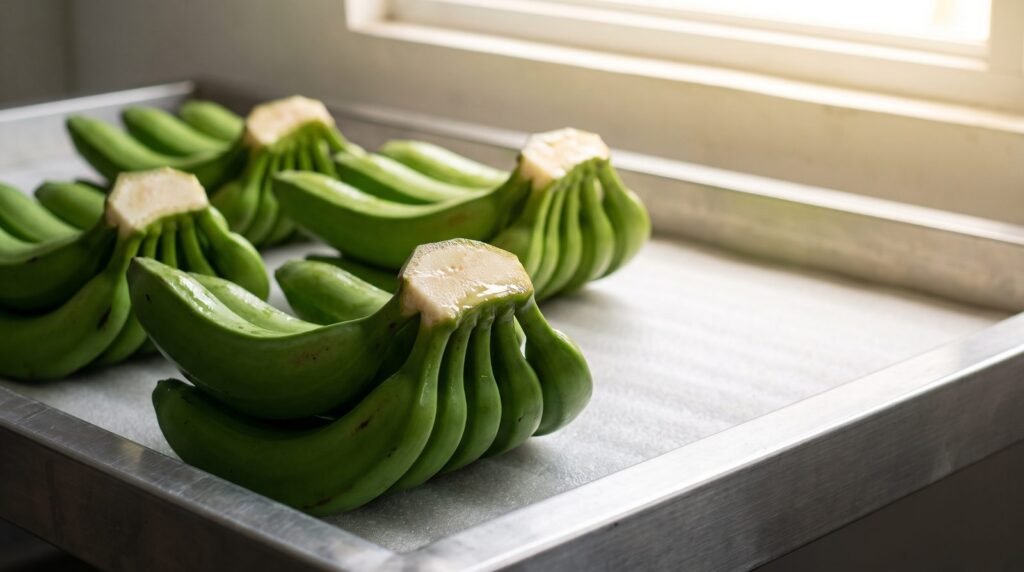
A container leaves the packing house with clean white cut surfaces on every cluster. Three weeks later the doors open and the crowns are furred grey-black. That is crown rot, and the banana crown rot postharvest disease complex is the defect buyers most often blame on the cold chain.
It is almost never the cold chain. The infection was already present when the doors closed, and the transit only gave it time. Here is where it starts, why it appears so late, and what actually reduces it.
What crown rot is, and what it is not
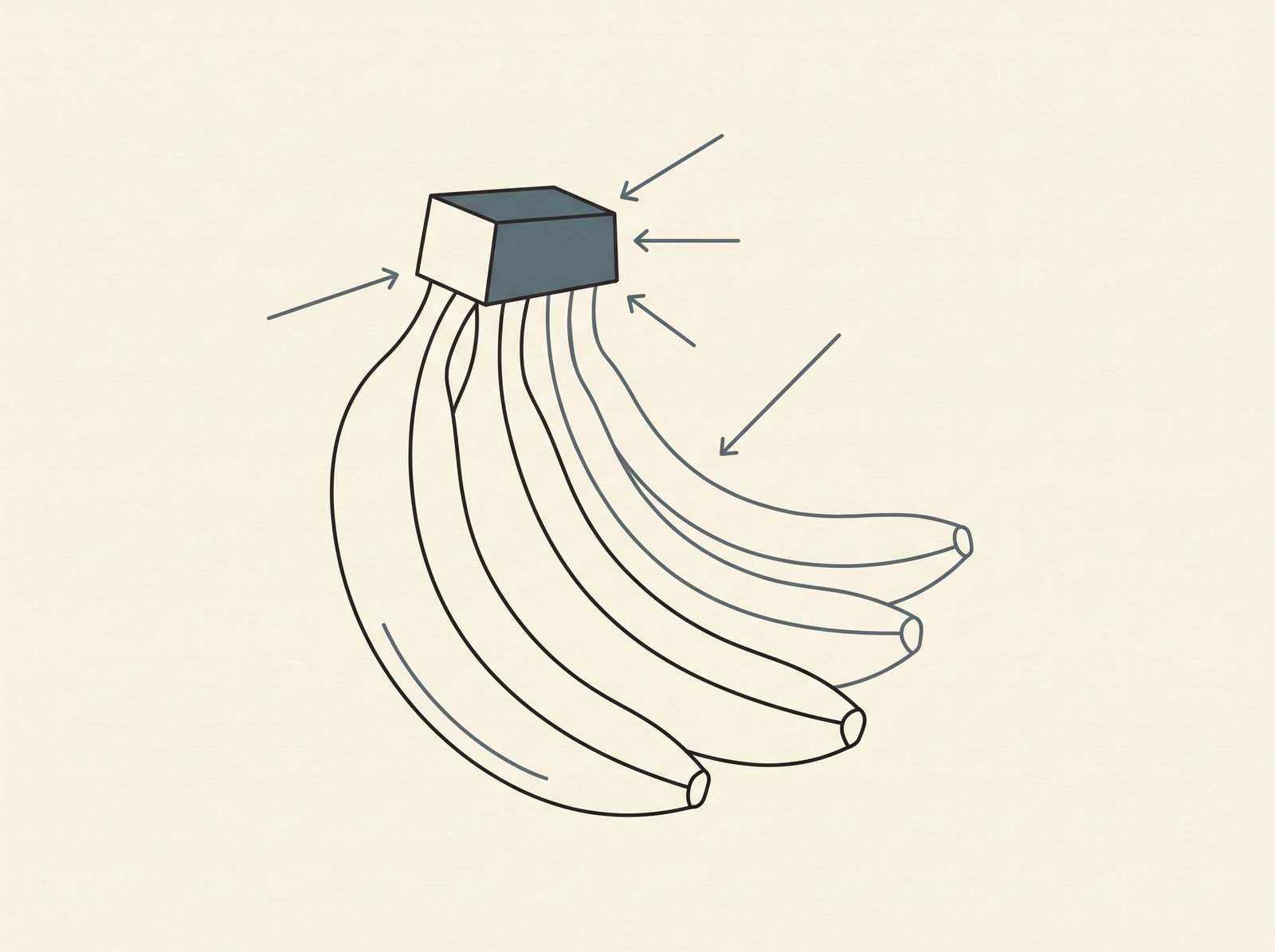
Crown rot is decay of the cut crown — the block of stalk tissue that holds a cluster of fingers together. In inspection language it is black rot confined to the crown of a cluster or hand, and it is scored as a percentage of that cluster’s fingers rather than finger by finger.
That scoring matters commercially. A cluster whose crown has gone but whose fingers are sound is still a rejection at a supermarket backdoor, because the cluster falls apart when it is handled.
The banana crown rot postharvest disease is a complex, not one fungus
There is no single crown rot pathogen to test for, which is why a supplier who promises to eliminate one organism has not understood the problem.
| Survey | What was recovered |
|---|---|
| North Queensland, Australia (industry project BA13011) | Musicillium theobromae and Fusarium spp. most consistently, and only in symptomatic crown tissue; Thielaviopsis musarum behind a faster, more severe form; Colletotrichum musae aggressive in tests but rare on market samples; Lasiodiplodia theobromae also isolated |
| Five organic plantations, Dominican Republic | Fusarium in 47% of isolates, Lasiodiplodia 7.4%, Colletotrichum 1.1%, from 1,495 colonies taken across the packing steps |
Read those two rows as what they are: isolation frequencies from particular regions and particular packing systems, not a global incidence rate. The useful conclusion is structural. Crown rot is caused by a group of common, weakly aggressive fungi that are already present around a packing house, and control works on exposure and on wound condition rather than on a single target.
The infection happens at the cut, in the packing house
Clusters are created by cutting. Hands come off the stem, the crown is trimmed square, and for a few minutes a large area of soft, wet, nutrient-rich tissue is open to whatever is in the air and in the water.
The Australian project concluded that infection most likely occurs at exactly those two moments — dehanding from the peduncle and final trimming in the shed — through airborne contamination, with field infection not excluded. The Dominican survey points at the same two steps and adds the washing tanks, naming final crown trimming, washing, and water quality during the application of protective products as the critical control points.
Trough water is a plausible carrier: samples from it yielded Fusarium spp. and in some cases M. theobromae. Water that starts clean at six in the morning has handled several tonnes of cut tissue and latex by midday, and nothing about its appearance announces when it stopped being clean.
Why it only shows after the doors open
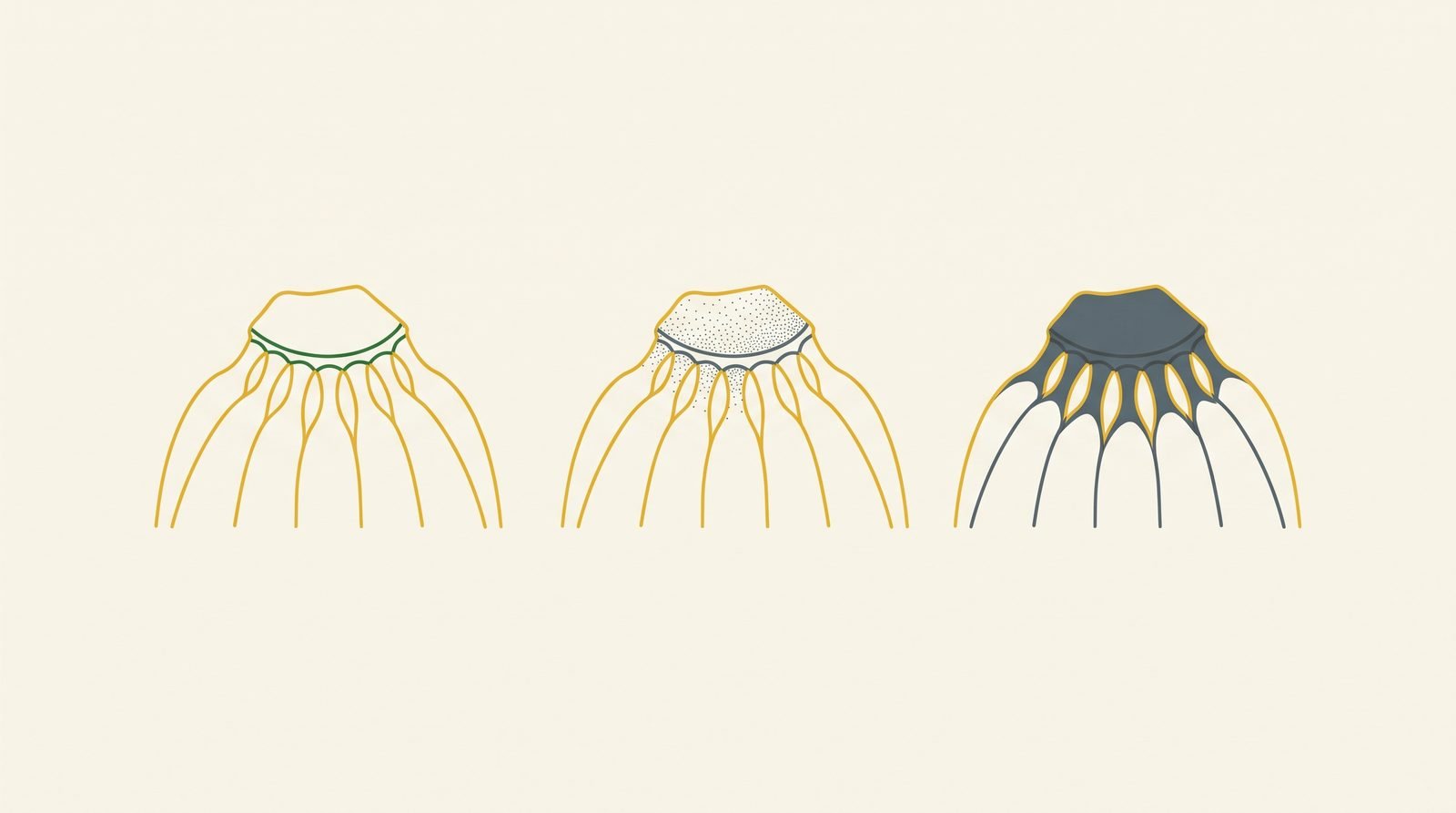
What you can see at the moment of packing is, at most, surface mould on the cut face. The rot that matters develops behind it, and it needs time and humidity.
- Time. Storage beyond roughly two weeks sharply increased symptoms in the Australian work, which cited 2–3 week domestic transits as the problem cases. An Asian sailing sits in that window.
- Humidity at the crown. Shrink wrap on packed clusters loses its seal as the fruit ripens and the resulting pocket of humid air favours crown rot and flower-end mould.
The handling that buys banana green life is largely the same handling that limits crown rot: the longer the fruit sits green and warm, the longer the fungus has.
What actually reduces it
The evidence is unromantic. In the Australian project, postharvest fungicide was the only single practice that met market expectations on its own, and field and shed practices on their own gave incremental benefit. Biological products and disinfectants tested less effective than the standard actives.
Rather than an argument for spraying more, that is an argument for stacking the cheap measures:
- Shed hygiene is measurable. Comparing two growers, mean crown end rot rating was 1.7 for the one combining a postharvest treatment with strict hygiene against 2.7 for the one doing neither, on a 0–8 scale.
- Water management. Change tank water on a schedule tied to throughput rather than to the clock, and treat the water used for any protective application as part of the treatment.
- A clean, square cut. A ragged crown has more surface and more crushed tissue. Knife hygiene belongs on the same schedule as the water.
- Short time to cooling. Every hour the crown spends warm and wet is incubation time.
- Resistance is real. The same project found sensitivity shifts in M. theobromae on one coast, attributed to historical use of one chemical group, and recommended restricting those products to other regions. A single active used indefinitely stops working.
Which postharvest actives are permitted at all, and at what residue limit, is set by the destination market rather than by the packer. That makes it a specification question to settle before the first order, not a detail to discover on arrival — the same discipline that applies to the rest of a supermarket banana specification.
What to ask a supplier, and what to check on arrival
Four questions separate a packing house that manages crown rot from one that hopes:
- How often is dehanding and trough water changed, and against what measure?
- How long is it from dehanding to the cold room, in hours, on a normal day and on a peak day?
- What crown treatment is applied, and is it permitted in my market at my residue limit?
- What crown rot incidence was recorded on the last shipments to a transit of my length?
On arrival, score crowns separately from fingers and record where in the load each sample came from. Crown rot spread evenly through the stow points back to the packing house; crown rot concentrated where airflow was poor points at the stow, which is the subject of our note on banana cartons and container loading.
Working with Dragon Hub
Dragon Hub packs and exports Cavendish bananas to buyers across Asia and the Middle East, and short regional sailings are the part of this we can use: less time in the window where crown rot develops. We would rather state our water-change and time-to-cooling practice and be held to it than quote a defect rate we cannot evidence. Specifications are on our product pages.
Frequently asked questions
What causes the banana crown rot postharvest disease?
A group of common fungi rather than one pathogen. Surveys recover Fusarium species, Musicillium theobromae, Lasiodiplodia theobromae, Colletotrichum musae and Thielaviopsis musarum in varying proportions by region. They enter through the freshly cut crown during dehanding and trimming, mainly from airborne contamination and tank water.
Is crown rot a cold chain failure?
No, though it surfaces during transit. The infection is established in the packing house at the cut surface, and the voyage supplies the time and humidity it needs. Cold chain matters because holding fruit longer, or outside the airflow, lets established infection progress further before the doors open.
Can crown rot be seen before shipping?
Only partly. Surface mould on the cut face may be visible at packing, but the rot that extends into the finger necks develops later. This is why crown rot is usually discovered at destination, and why incidence has to be managed through packing-house practice rather than through final inspection.
Sources
- Hort Innovation BA13011 — The cause and management of crown rot of banana: species recovered, infection at dehanding and trimming, trough water isolates, storage duration and shrink wrap effects, hygiene comparison ratings, fungicide efficacy and sensitivity shifts
- ISHS — Source and spread of fungal pathogens causing crown rot disease in organic bananas: isolate proportions across packing steps in the Dominican Republic and the identification of dehanding, washing and water quality as critical points
- USDA AMS — Banana Inspection Instructions: the definition of crown rot as black rot confined to the crown, and how it is scored against the fingers of a cluster
