

Most Vietnamese fruit exporters have never sold a carton into Saudi Arabia, and many of them are supplying it anyway. Dubai importers re-export a large share of what they land, and when buyers re-export fruit from UAE to Saudi Arabia, the second leg depends on paperwork issued in Vietnam for the first one.
That is the part worth understanding, because it is the part you control, and it is why Dragon Hub treats the certificate set as part of the product specification. If your original phytosanitary certificate is wrong in a way that was harmless at Jebel Ali, the UAE authority may be unable to issue the re-export certificate the next border wants, and the buyer will trace the problem back to you—correctly.
What Happens When Buyers Re-export Fruit from UAE to Saudi Arabia
A re-export is not a new export. The consignment entered the UAE under one set of plant health documents, and it leaves under a second document that refers back to the first. The international rule for this sits in the IPPC standard on phytosanitary certification, ISPM 12, which both the UAE and Saudi Arabia operate within.
The mechanics, in the standard’s own terms:
- The re-exporting country’s plant protection authority issues a phytosanitary certificate for re-export, and should do so only if it is satisfied the importing country’s requirements are met.
- The original phytosanitary certificate, or a certified copy of it, must accompany the consignment.
- The goods may have been stored, split, combined with other consignments or repacked, provided they were not exposed to pest infestation or contamination.
- If a consignment is split and the parts move on separately, each part needs its own re-export certificate and its own certified copy of the original.
- If the goods lost their integrity or identity, or were exposed to infestation, the authority should issue an ordinary phytosanitary certificate instead, still showing the country of origin.
Read the fourth point again if you sell full containers. A Dubai importer who breaks your container into three lots for three customers in the Kingdom is triggering three re-export certificates, each resting on your single original. One defect in that original becomes three stopped shipments.

Four Details on Your Original Certificate That Stop the Second Leg
The re-export certificate is issued against the original. So the fields that matter are the ones that have to still be true weeks later, at a different border, possibly for a fraction of the original quantity.
- Exporter and packer identity. The names on the certificate must match the names on the invoice, the packing list and the carton markings. A packhouse named one way on the certificate and another on the carton is the most common stoppage.
- Quantity and packaging description. If the certificate states a carton count and net weight, a split consignment has to reconcile against it. Vague or rounded quantities make reconciliation impossible.
- Botanical name of the commodity. Plant health authorities work in botanical names, not trade names. “Cavendish banana” without Musa spp. invites a query.
- Validity and declared point of entry. A certificate issued for one point of entry, or close to expiry on arrival, leaves the re-exporter nothing to work with.
None of this is unique to Saudi Arabia—it is the same discipline the first border asks for, just with less tolerance. Our UAE banana import documents checklist covers the first leg field by field, and the same care carries the shipment through the second.
What the Kingdom Asks For at Its Border
On the Saudi side, imported food clears through the Saudi Food and Drug Authority. SFDA’s published conditions for importing food require that fresh fruit and vegetables arrive with an official phytosanitary certificate issued by the competent authority in the exporting country, following the model format the Kingdom sets out, with fields for botanical name, declared quantity, place of origin, treatment, exporter and consignee, and point of entry.
A 2022 summary of SFDA circular 47084 listed the document set for fresh produce as a phytosanitary certificate or a phytosanitary certificate for re-export, the final invoice, the certificate of origin, the packing list, and organic certification where relevant, together with a five-year record retention requirement and SFDA’s right to sample consignments. That summary is now several years old and we could not confirm on SFDA’s own site that the circular stands unchanged, so treat the list as indicative and have the importer confirm the current requirement before shipping.
Two filings sit behind the clearance itself: the SFDA shipment request, and the customs declaration. Guidance published in September 2026 recommends filing them 48 to 72 hours before arrival and keeping product names consistent across the invoice, the registration and the declaration. The practical consequence for an exporter is the same as everywhere: inconsistent naming between documents causes more delay than any physical problem with the fruit.
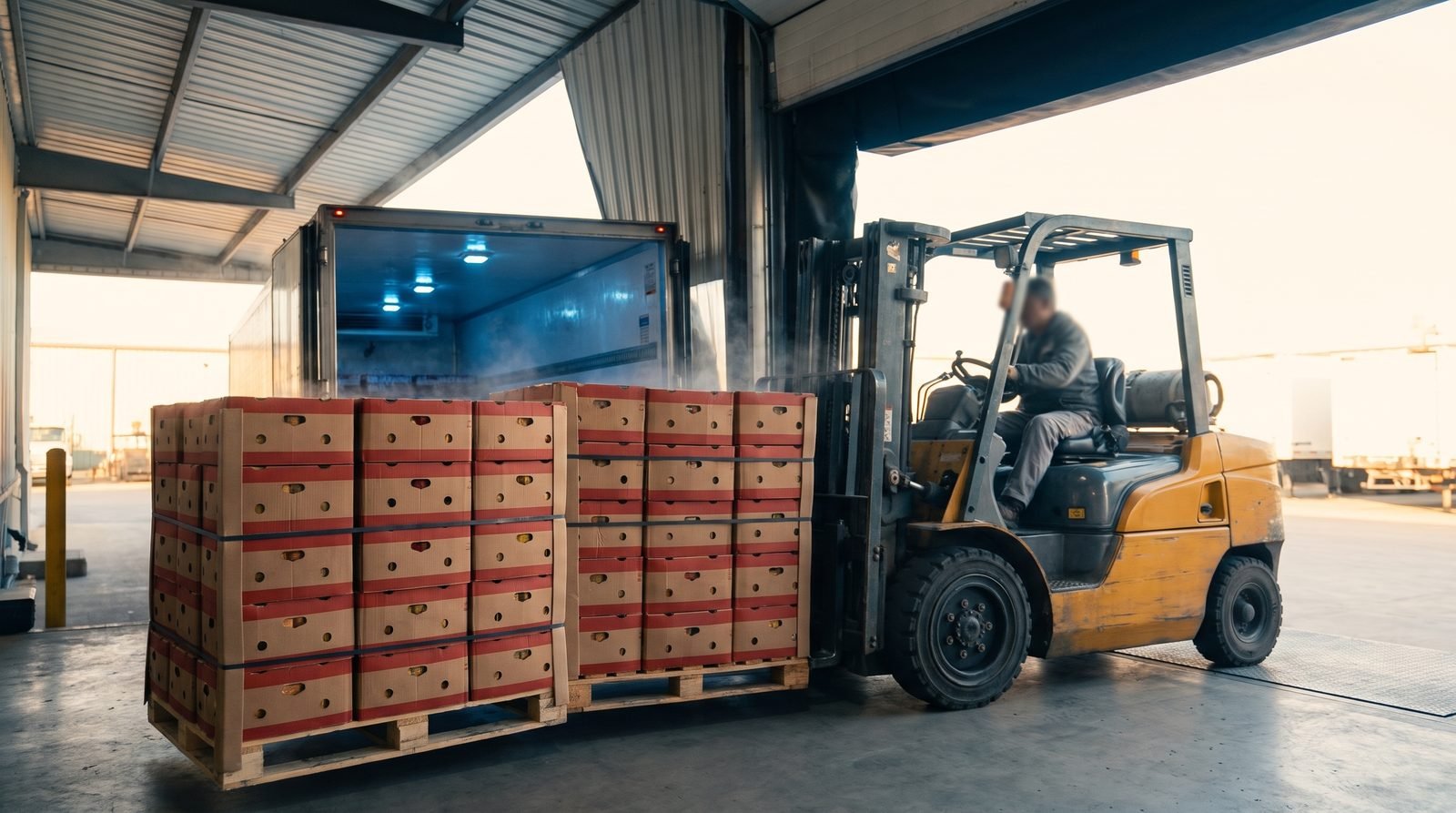
The Gulf Standards Both Countries Use
One reason this corridor is workable is that the UAE and Saudi Arabia apply the same family of GSO standards, so packing correctly for one is most of the work for the other:
- GSO 123—general requirements for fresh fruits and vegetables.
- GSO 124—general requirements for fresh fruit and vegetable boxes, which is what governs your carton.
- GSO 9—labelling of prepackaged foodstuffs, the source of the Arabic labelling requirement.
- GSO 323—transport and storage of chilled and frozen foods.
Pesticide residue limits are the other shared layer, and where no Gulf or national limit exists, Codex limits are generally applied. Packing to the stricter reading of these standards rather than the minimum is what keeps a lot eligible for a second leg you may not have been told about.
Making a Shipment Re-export Proof
A short list that costs nothing at origin and saves a container later:
- Ask the buyer, before packing, whether any part of the lot is destined for onward sale into the Kingdom or elsewhere in the Gulf.
- Keep the packhouse and exporter names identical across certificate, invoice, packing list and carton print.
- State quantities precisely, in units that survive a split.
- Include the botanical name alongside the trade name.
- Pack and label to GSO 124 and GSO 9 from the start, rather than correcting cartons at destination.
- Keep scanned originals filed for at least five years, matching the retention the Kingdom expects of importers.
If a consignment is held at either border, the questions asked are documentary first and physical second—the same pattern we describe in Jebel Ali customs clearance for fresh fruit.
How Dragon Hub Prepares Documents for a Re-export Buyer
We treat the certificate set as part of the product specification rather than as something the forwarder tidies up at the end: consistent packhouse and exporter naming, botanical names on the plant health paperwork, exact carton and weight declarations, and carton marking designed to match the documents rather than the other way round. For an importer who re-exports, that consistency is what makes the second leg possible at all.
If your programme includes onward sale into the Gulf, tell us at the quotation stage and we will build the documentation set around it. Current lines are listed under products.
Frequently Asked Questions
Who issues the phytosanitary certificate for re-export?
The plant protection authority of the re-exporting country—so for goods leaving the UAE, the UAE authority, not the Vietnamese one. It is issued against your original certificate, which is why the original has to travel with the consignment as an original or a certified copy.
Can a container be split and still re-exported?
Yes. Storage, splitting, combining and repacking are all permitted under the international standard, provided the goods were not exposed to pest infestation or contamination. Each separately exported part then needs its own re-export certificate and its own certified copy of the original certificate.
Does the fruit need a new certificate from Vietnam for the second leg?
No. The second leg runs on a re-export certificate issued in the UAE. What the UAE authority needs from Vietnam is the original certificate intact and accurate. If the original cannot support the re-export, the fix is not a new Vietnamese certificate for goods that have already left the country.
What goes wrong most often?
Name and quantity mismatches between the certificate, the invoice, the packing list and the carton markings. Nothing is wrong with the fruit; the documents simply cannot be reconciled, which is enough to stop a consignment at a border that works document-first.
Do GSO standards differ between the UAE and Saudi Arabia?
The core standards for fresh produce, boxes, labelling and chilled transport are shared GSO standards applied by both. National requirements layer on top, particularly around registration, conformity certificates and testing, so confirm the destination-specific items with the importer rather than assuming the Gulf is one rulebook.
