
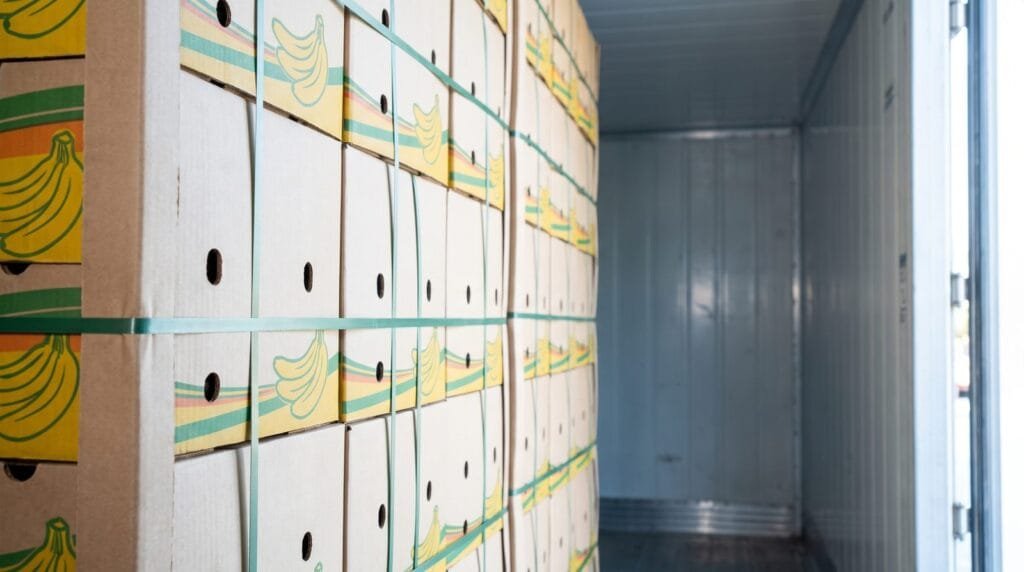
Two containers leave the same packhouse on the same day with the same fruit. One carries about 16 tonnes, the other about 21. The freight bill is identical. That gap is what this page is about.
Banana export packaging and container loading is usually treated as the forwarder’s problem. It is not: it sets your cost per kilo on the shelf, and it is decided before anyone quotes you a price.
Banana export packaging and container loading: the carton
The export banana carton is a two-piece telescopic corrugated box, typically five-ply moisture-resistant board, measuring roughly 500 × 320 × 200–210 mm externally. The world standard net weight is 13.5 kg, with a gross of about 14.2 to 14.5 kg. Dragon Hub packs at 10 kg or 13 kg, or to a buyer’s own specification.
What is inside the box matters as much as the box:
- A polyethylene liner around the fruit. This is not wrapping — it holds the atmosphere around the bananas for the whole voyage and is part of the cold chain.
- Foam sheeting between hands, because bananas bruise against each other before they bruise against the carton.
- An absorbent pad in the base.
- Die-cut vent holes aligned top and bottom, so that cold air passes through the stack rather than around it. Misaligned cartons turn a ventilated stow into a solid block.
The container
A 40-foot high-cube reefer has internal dimensions of about 11.58 × 2.29 × 2.50 m — roughly 67 cubic metres — with a tare of 3,900 kg and a maximum payload around 28,350 kg.
One detail catches people out: the refrigeration ductwork in the ceiling takes roughly a foot of height compared with a dry high-cube. A pallet configuration that just fits a dry container will not necessarily fit a reefer, and the space above the stow is not spare — it is the return air path, which is why cargo must never be stacked above the red load line. The reasoning behind that and the rest of the regime is in our note on reefer container settings for bananas.
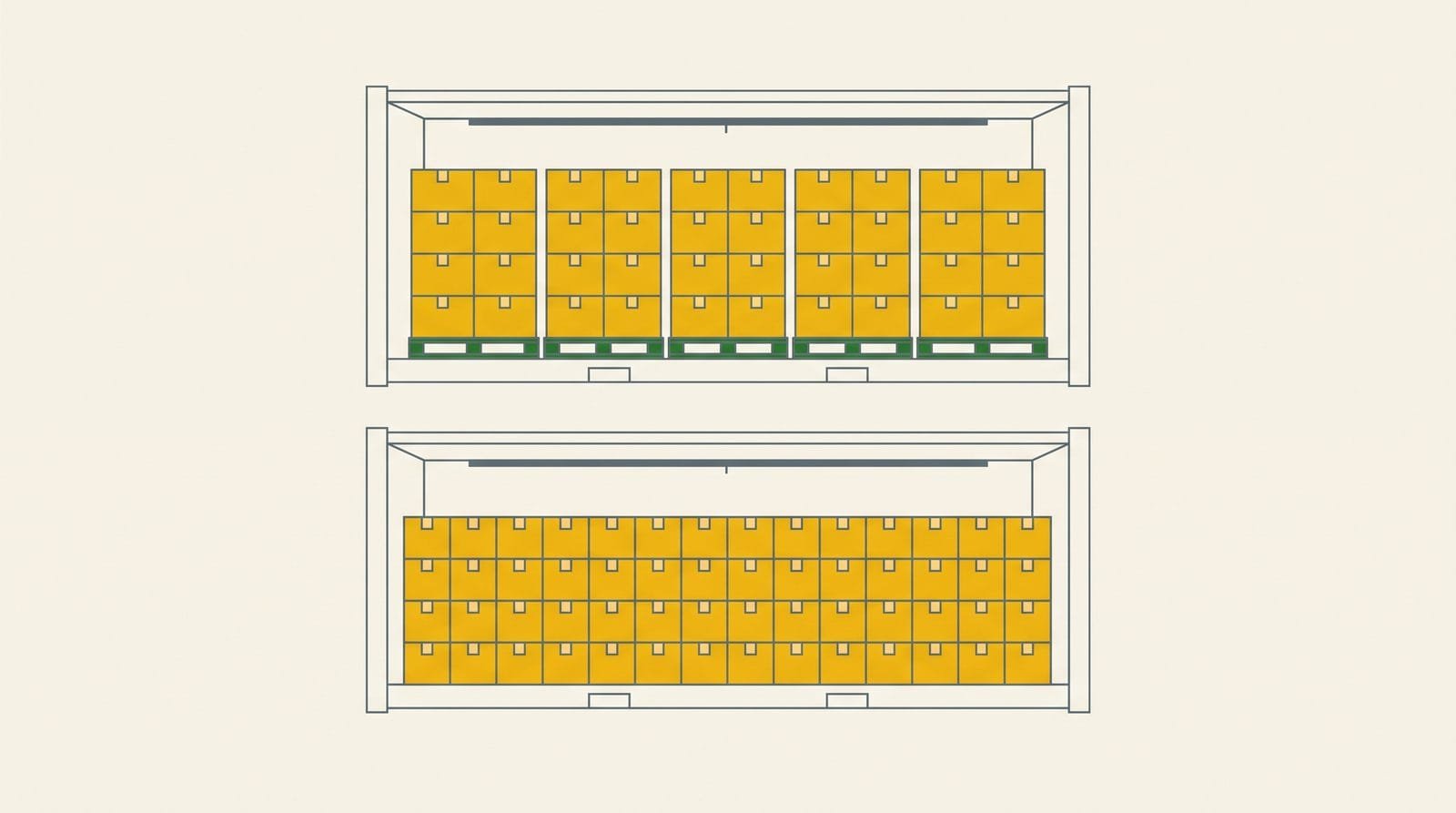
Palletised or floor-loaded: the difference is 28 %
| Palletised | Floor-loaded | |
|---|---|---|
| Cartons per 40 ft HC reefer | ~1,200 (20 pallets) | ~1,540 |
| Net fruit at 13.5 kg/carton | ~16.2 t | ~20.8 t |
| Ocean freight per kg | Higher | ~28 % lower |
| Loading and discharge | Fast, forklift | Slow, manual |
| Handling touches per carton | Few | Many |
Floor-loading puts roughly 340 more cartons, about 4.6 tonnes of fruit, into the same container for the same freight. On a long lane that is a serious number.
It is not free. Every extra carton is handled by hand at both ends, which is labour, time at the dock and more opportunity for bruising — and bruised fruit fails on arrival for reasons that look like cold chain failures but are not. Pallets cost you volume and buy back speed, consistency and fewer touches.
The honest rule: floor-load when the freight saving is larger than the handling cost and your receiving end can take it; palletise when discharge speed, labour cost or damage claims matter more. Decide it at enquiry, because it changes the quotation.
Why weight is never the limit
Run the arithmetic on the fuller case. At 1,540 cartons and roughly 14.35 kg gross, a floor-loaded container of bananas grosses about 22.1 tonnes against a payload limit of 28,350 kg. Palletised, it is nearer 17.7 tonnes including the pallets.
So a banana container never hits its weight limit. It runs out of space and airflow first, every time. That is worth knowing because it changes which questions are useful: asking for a heavier payload allowance achieves nothing, while asking about stow pattern, vent alignment and clearance around the block achieves a great deal.
Print and pallet type
Two smaller decisions that are easier to make early than late.
Carton print. Your own brand, a neutral box, or the supplier’s. Own-brand is the obvious choice for a retail programme, but neutral cartons are worth considering if you resell part of a container or move fruit between customers — a printed box commits the cargo to one buyer before it has arrived. Print also carries a lead time of its own, which is a poor thing to discover in the week you wanted to ship.
Pallet type. Standard 48 by 40 inch pallets give the 20-pallet configuration above; Euro pallets at 1200 by 800 mm can reach 23 in the same box, though the practical number depends on stack height and how much clearance the stow needs. Match the pallet to the racking and the forklifts at the receiving end rather than to whatever fits best in the container — a pallet that does not suit the warehouse gets broken down on arrival, and the speed advantage disappears with it.
What carton weight does to your shelf price
Carton weight is a retail decision wearing a logistics costume. A lighter box turns faster, is easier to handle on the shop floor and gives a lower shelf price per unit; a heavier box gives a better cost per kilo and fewer cartons to move. Between 10 kg and 13.5 kg the count per container changes, the freight per kilo changes, and so does your price per piece.
Fix it before you compare quotations, not after. Length and grade sit on a separate axis — our guide to Cavendish banana grades and sizes covers those fields.
Working with Dragon Hub
Dragon Hub packs and exports Cavendish bananas to supermarket and wholesale buyers across Asia and the Middle East, at 10 kg or 13 kg or to your own carton specification, palletised or floor-loaded to suit your receiving end. The full specification is on the Cavendish banana page, alongside the rest of our product range. Tell us your destination, your carton and how you discharge, and the quotation will reflect all three.
Frequently asked questions
How many banana cartons fit in a 40ft reefer container?
About 1,540 cartons floor-loaded, or about 1,200 on 20 pallets. At the standard 13.5 kg net that is roughly 20.8 tonnes against 16.2 tonnes of fruit for the same freight cost, which is why the loading method belongs in the quotation rather than in the shipping instructions.
What are the dimensions of a banana export carton?
Roughly 500 by 320 by 200 to 210 mm externally, as a two-piece telescopic five-ply corrugated box. The world standard net weight is 13.5 kg with a gross around 14.2 to 14.5 kg, though 10 kg and 13 kg cartons are common in Asian and Middle East programmes.
Is floor-loading better than palletising bananas?
It carries about 28 % more fruit for the same freight, but every carton is handled manually at both ends, which costs time at the dock and risks bruising. Floor-load when the freight saving beats the handling cost and your warehouse can take it; palletise when discharge speed or damage claims matter more.
Does a banana container ever reach its weight limit?
No. Even fully floor-loaded, a 40-foot reefer of bananas grosses around 22 tonnes against a payload limit near 28.35 tonnes. The binding constraints are volume and airflow, so questions about stow pattern and vent alignment are more useful than questions about payload.
Sources
- Cavendish banana export packaging specifications: carton construction, dimensions, net and gross weight, liner and pads, cartons per container
- 40-foot reefer high-cube specifications: internal dimensions, tare, payload and cubic capacity
- Pallet capacity of a 40-foot reefer: pallet count and the ceiling height lost to ductwork
