
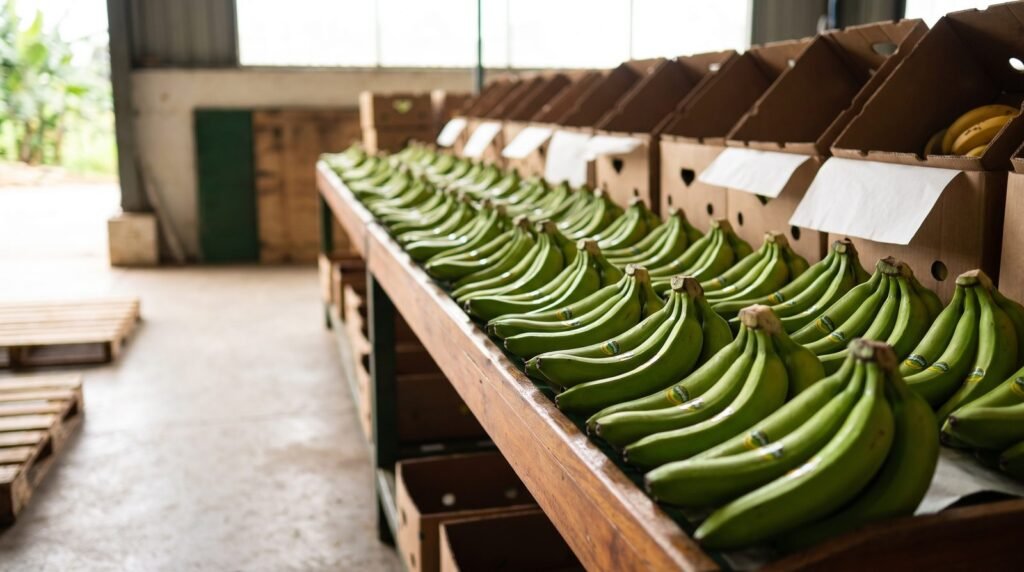
Most rejected containers are not failures of growing or shipping. They are failures of wording. A banana specification for supermarket programmes has to be measurable by someone who was not in the meeting, at a place and time both sides agreed on, with a number attached to every tolerance.
What follows is the field list, where the legal floor sits, how much higher commercial programmes actually run, and the one clause most specifications leave out.
What a banana specification for supermarket programmes has to do
A retail programme runs on repeatability. The buyer is not asking for the best fruit available; they are asking for the same fruit every week, so that a shelf plan, a price and a ripening schedule all hold. That changes what a specification is for.
Two tests are worth applying to every line you write. Can it be measured with equipment that exists at the inspection point? And does a failure have a stated consequence? A clause that passes neither is a wish, and both sides will read it differently on the day it matters.
Start from the legal floor
The marketing standard for bananas retained in UK law, Regulation 1333/2011, is a useful anchor because it defines the measurements rather than just naming them. Minimum finger length is 14 cm, measured along the convex face from the blossom end to the point where the peduncle joins the crown. Minimum grade is 27 mm, the thickness of a transverse section between the lateral faces and the middle, perpendicular to the long axis.
It also names the reference finger, which is where disputes usually start: the median finger on the outer row of a hand, or the finger next to the cut on the outer row of a cluster. If your specification does not say which finger is measured, it has not specified length at all.
The three classes carry numbers too. Extra allows slight superficial blemishes over no more than 1 cm² of a finger’s surface, Class I up to 2 cm² with slight shape defects and rubbing, Class II up to 4 cm². In no class may a defect reach the flesh.

Then the tolerances, applied within each package. Extra permits up to 5 per cent by number or weight that only meet Class I. Class I and Class II each permit up to 10 per cent falling to the class below, with Class II excluding fruit affected by rot. On size, all classes permit 10 per cent by number outside the sizing requirement, limited to 1 cm under the 14 cm minimum.
Presentation is specified as well: hands or clusters of at least four fingers, or single fingers; up to two fingers may be missing from a cluster if the stalk is cleanly cut without damaging the neighbours; no more than one three-finger cluster per row. Crowns must be cleanly cut, without bevelling or tearing, sound and free of fungal contamination. Our note on Cavendish grades and sizes goes through the classification in more detail.
Then write above it, because programmes do
The floor is a floor. A published Costa Rican export specification shows how much tighter a commercial grade runs: Premium calls for a minimum finger length of 8 inches, roughly 20 cm, against a 14 cm legal minimum, with a package grade range of 8 to 18, a maximum of 18 clusters per box at 4 to 8 fingers each, and about 110 fingers per box. Its Class I sits at a 7 inch minimum, grade 7 to 17, 3 to 9 fingers per cluster, up to 20 clusters and 120 fingers. Carton net weight is 18.14 kg at the supermarket.
Treat those as an illustration rather than a target. They are one origin’s commercial grade, published in 2022, not a standard, and a Vietnamese programme should be written against what Vietnamese fruit reliably delivers. The point is the shape: a programme specification names length, grade range, cluster count, finger count and carton weight together, because changing one changes the others.
Carton weight deserves its own line for a separate reason. Net weight, declared tolerance and the stow pattern decide how many cartons fit and what the freight per kilo is, as our note on cartons and container loading sets out. Comparing two quotations written to different carton weights compares nothing.
Cutting maturity and the colour you want at the door
Two fields decide arrival condition more than anything else in the document, and both are routinely left to the supplier by default.
Cutting maturity, first. The practical index is the degree of fullness of the fingers, the disappearance of angularity in a cross section. Fuller fruit eats better but carries less reserve against delay. Mature-green fruit holds a postharvest life potential of two to four weeks in air at 14 °C, and that budget is what the maturity decision spends.
Second, the colour stage you want at your door, not simply “green”. State it on a numbered scale and state where it is assessed; our note on ripening stages and the colour index covers the numbering and what each stage is used for commercially. Ripening itself runs at 15 to 20 °C with 100 to 150 ppm ethylene for 24 to 48 hours at 90 to 95 per cent relative humidity, so a programme that names a stage is also naming who does that work.
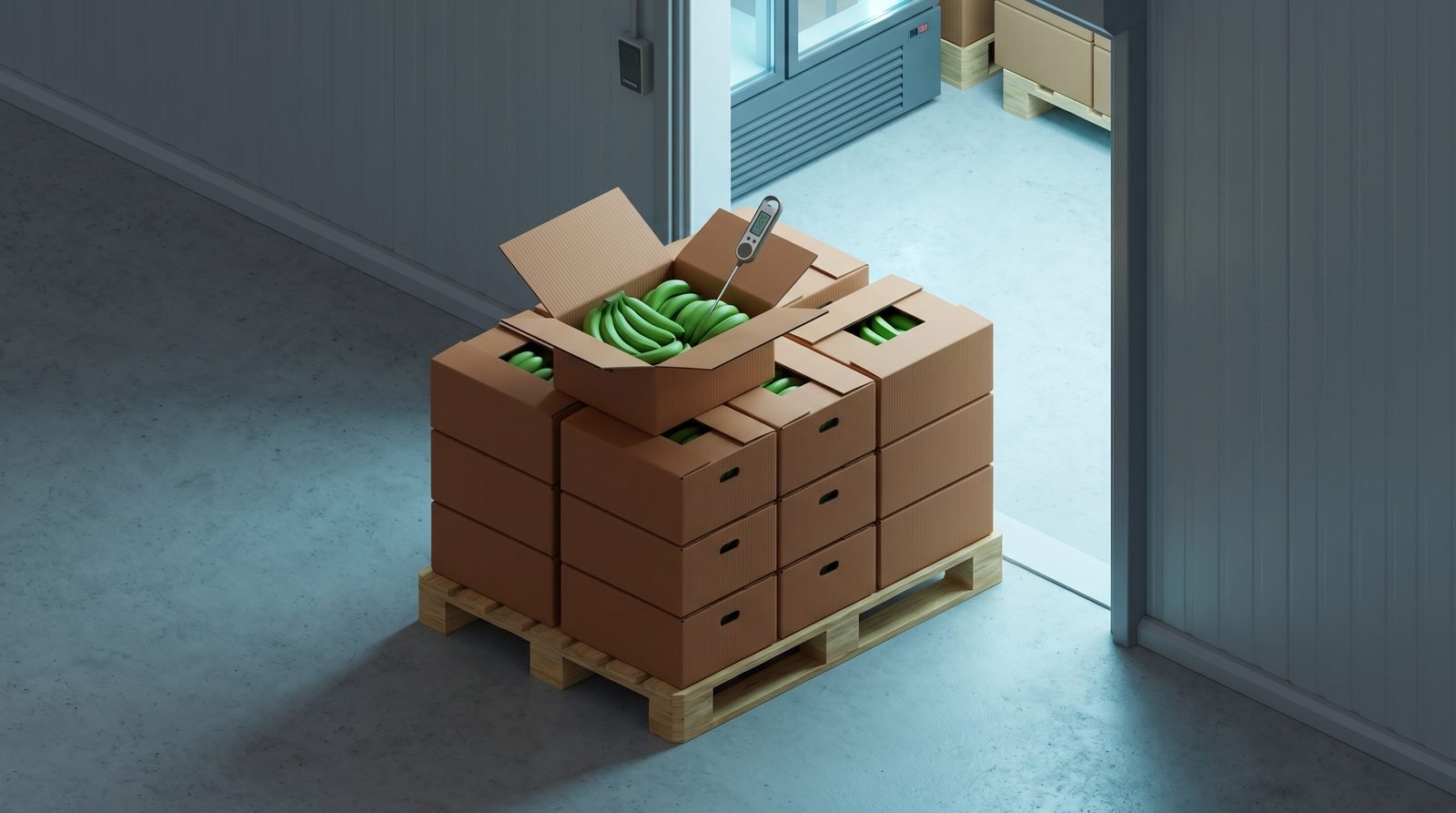
Transport temperature belongs in the same paragraph. Green fruit travels at 13 to 14 °C, and injury below that is a matter of dose and time rather than a threshold: moderate injury in mature-green fruit has been recorded after one hour at 10 °C or seventy-two hours at 12.8 °C. Chilled fruit will not ripen properly afterwards, so a specification that names a colour stage without naming a temperature regime has left a gap.
The clause most specifications leave out
Tolerances mean nothing without a sampling rule. A document that says 10 per cent outside specification is acceptable, without saying how that 10 per cent is established, has invited two honest parties to reach different conclusions from the same container.
Write four things down. Where inspection happens and at what point in time. How many cartons are drawn and how they are selected. Who measures, and with what. And what follows a failure, graded by severity rather than left as a single word.
The field list, to copy
- Variety and subgroup, stated explicitly
- Minimum finger length, with the measurement method and the reference finger named
- Grade range in millimetres or thirty-seconds, with how the section is taken
- Class, with the blemish area allowance in cm² written out rather than implied
- Defect tolerance per package, by number or weight, and the handling of rot separately
- Presentation: hand or cluster, fingers per cluster, clusters per carton, crown cut
- Carton net weight, declared tolerance, liner and pad specification
- Cutting maturity, expressed as finger fullness, with grade at harvest
- Transport temperature, relative humidity and ventilation setting
- Colour stage required at the agreed delivery point, on a numbered scale
- Pulp temperature acceptable at the door
- Residue compliance against the named destination limits
- Inspection point, sample size and selection method
- Consequences of a failure, graded by severity
Working with Dragon Hub
Dragon Hub packs and exports Cavendish bananas to supermarket and wholesale buyers across Asia and the Middle East, and the fastest conversations start from a document like the one above. Send the specification you work to and we will answer it line by line, including the lines we would want changed before committing to a weekly programme. Our product pages set out what we pack.
Frequently asked questions
What should a banana specification for supermarket programmes include?
Variety, finger length with its measurement method, grade range, class and blemish allowance, defect tolerance per package, presentation and crown cut, carton net weight, cutting maturity, transport temperature, the colour stage wanted at delivery, residue compliance, and an inspection clause naming sample size and consequences.
What is the minimum size for export bananas?
Under the marketing standard retained in UK law the minimum is 14 cm in length and 27 mm in grade, measured on a named reference finger. Commercial retail programmes commonly specify well above that floor, so the legal minimum is best read as a disqualifier rather than a target.
How much out-of-specification fruit is normally allowed?
The standard allows 5 per cent by number or weight in Extra and 10 per cent in Class I and Class II, plus 10 per cent on sizing with a 1 cm floor below the minimum length. Those figures only work if the specification also says how the percentage is established.
Should the specification name a colour stage or just say green?
Name a stage on a numbered scale, and name where it is assessed. Green covers several commercially different conditions, and the gap between them is the difference between fruit that ripens on your schedule and fruit that arrives already turning.
Sources
- Marketing standards for bananas, Regulation 1333/2011 Annex I as retained in UK law: minimum length and grade, measurement method, classes, tolerances and presentation
- Technical specifications of bananas in Costa Rica: a commercial Premium and Class I grade, cluster and finger counts, and 18.14 kg carton net weight, published 2022
- UC Davis Postharvest — Banana: maturity index, green life potential, transport and ripening temperatures, ethylene dose and the chilling injury table
