
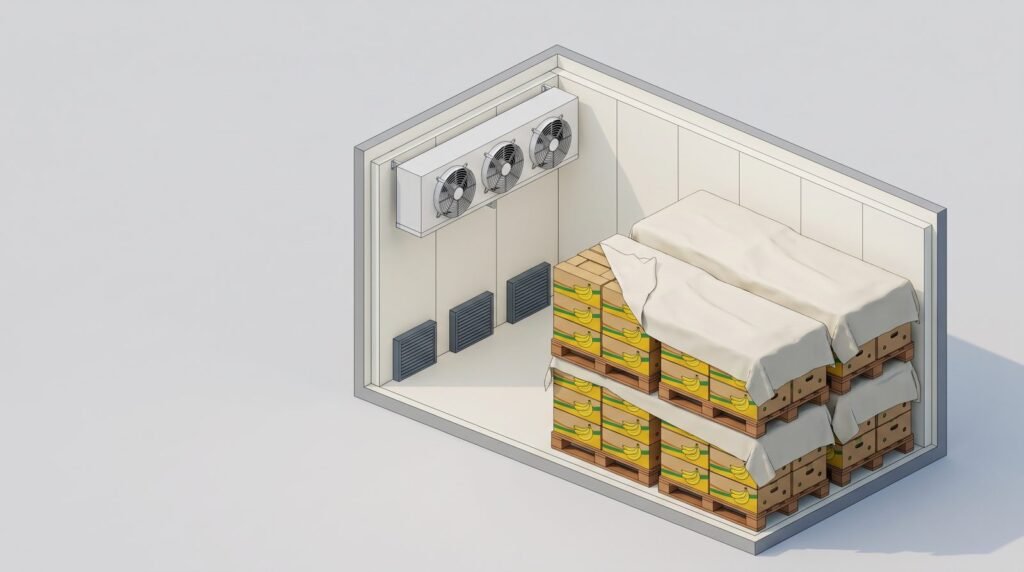
Plenty of fruit importers in Singapore and Malaysia move a container or two of bananas a month and have no industrial ripening facility to put them in. The question is whether a small scale banana ripening room can do the job properly, or whether it only looks cheaper than buying fruit that someone else has already ripened.
It can be done, and it is less forgiving than a big room for reasons of physics rather than budget. Here are the conditions it has to hold, the kit genuinely required, and the two failure modes that cost a pallet.
What the room has to do, in four numbers
Ripening is a gassing step followed by a holding step, and the gassing conditions are not approximate:
| Condition | Target |
|---|---|
| Ethylene concentration | 100–150 ppm |
| Exposure | 24–48 hours |
| Air temperature during ripening | 15–20 °C |
| Relative humidity | 90–95% |
| Carbon dioxide | below 1% |
The ethylene dose is small in absolute terms: about 0.1 cubic feet of ethylene per 1,000 cubic feet of room volume gives roughly 100 ppm. The commodity storage manuals put pulp temperature during gassing at 14–18 °C depending on how fast you want the cycle, and that range is the practical lever — ripening can run in as little as four days at the warm end or eight to ten days at the cool end.
Temperatures are set against pulp temperature, not room air.
A small scale banana ripening room: the minimum kit
Strip out everything optional and the list is short, but nothing on it can be dropped:
- An insulated, near-airtight room that holds temperature within a couple of degrees. Leakage is what makes a small room hard: the same crack costs proportionally more ethylene in 60 cubic metres than in 600.
- Heating for cool weather or a cold night, electric only. Open-flame heating in a ripening room is prohibited for good reason.
- Humidification, or at least a way to check humidity, to hold 90–95% during ripening.
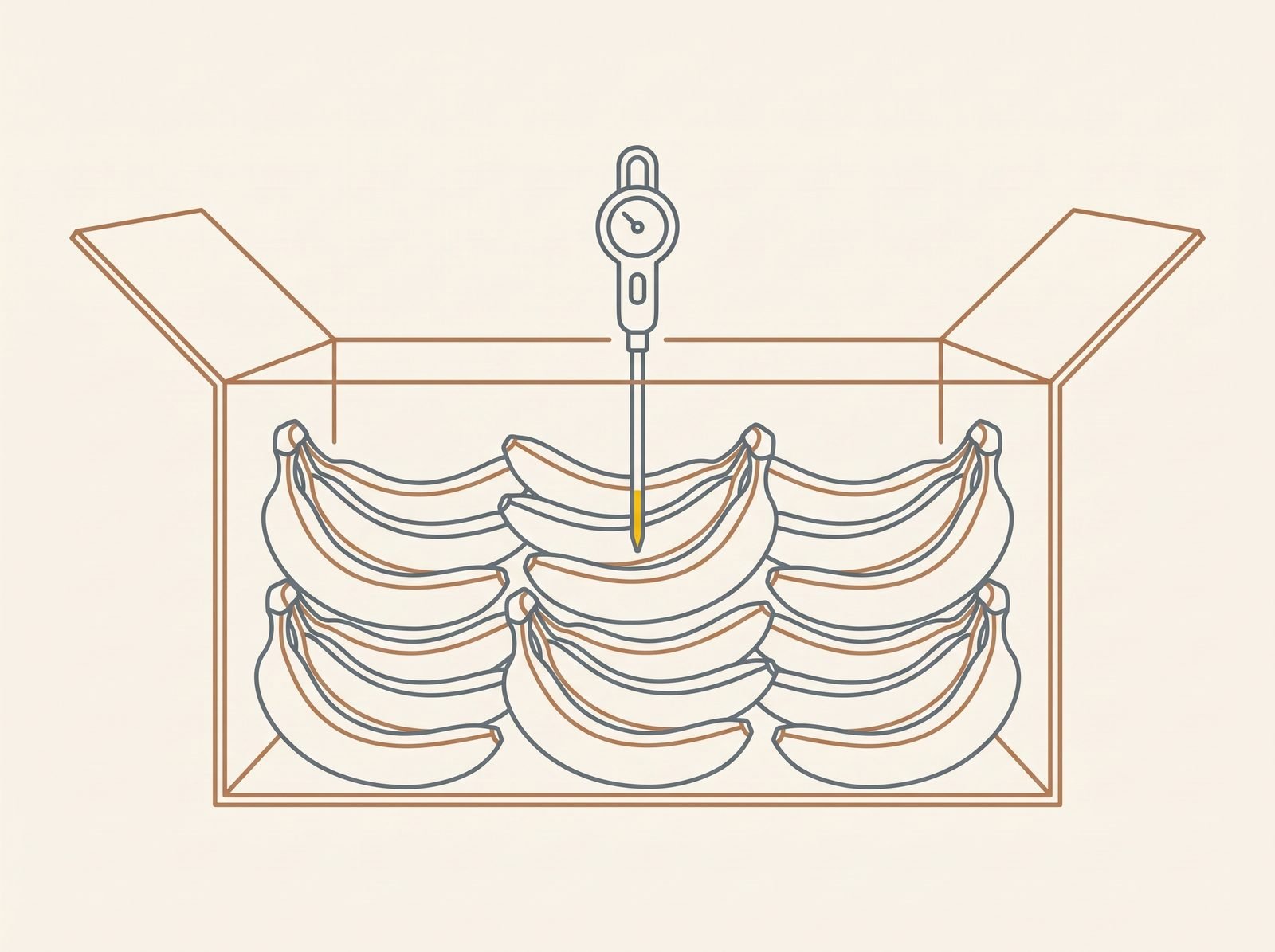
- A pulp probe thermometer, and ideally a way to air-test ethylene concentration, because room tightness varies and the dose you intended is not necessarily the dose you got.
The number that decides your refrigeration
A banana generates heat while it ripens, and the warmer it gets the more heat it generates. Respiration measured as carbon dioxide output runs roughly 10–30 ml per kilogram per hour at 13 °C and 20–70 ml at 20 °C.
Moving a load from holding temperature into the ripening window roughly doubles its own heat output, and the room has to absorb that on top of ambient load and door openings. This is the common mistake in a converted cold room: sized to keep fruit cold, it holds setpoint with the fruit asleep and loses control once the fruit wakes. If you are converting a cold room rather than building, that calculation comes first, and the reefer setpoints the fruit arrived on are the starting condition.
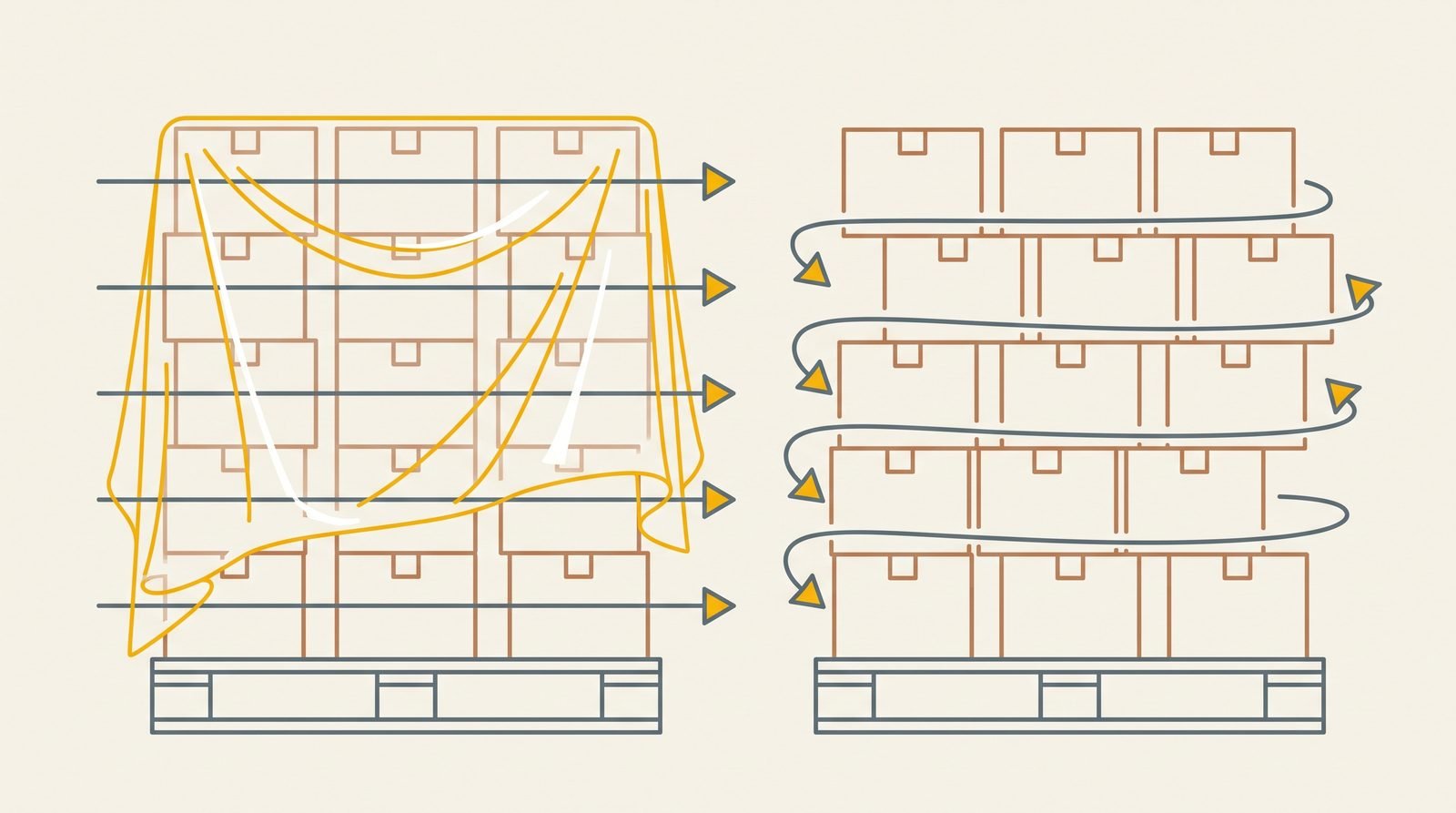
Air has to go through the cartons, not around them
Pulp temperature in the middle of a pallet can sit two or three degrees from the room reading, and the result is one pallet arriving in two colour stages.
- Pressurised (forced-air) rooms tarp the top and the outer ends of the pallet rows so air is pushed through the cartons rather than past them. Fans sit high on the back wall with intakes below. Pallets stack two or three tiers, and the cartons carry extra vent holes. The storage manuals recommend this arrangement for any new facility.
- Conventional rooms rely on stacking: boxes offset so air can move between them, with an air channel of about 100 mm (4 inches) between adjacent rows.
- Fans run continuously through the cycle in either arrangement.
Carbon dioxide is what stalls a small room
Above 1% — 10,000 ppm — carbon dioxide blunts ethylene’s effect and slows ripening, and a room full of respiring fruit produces it continuously. A small, tight room reaches that level faster than a large one.
So the two requirements pull against each other. The room has to be tight enough to hold an ethylene dose, and ventilated enough to shed carbon dioxide. The usual resolution is sequencing: gas the room, leave it sealed for the first 24 hours, then open the doors for about 20 minutes every 12 hours, or run timed or sensor-driven ventilation instead. Continuous flow-through ventilation does the same job if the generator is sized for it.
One safety note, and an argument for a specified generator over an improvised cylinder: ethylene is explosive in air between roughly 2.8% and 28.6%. The ripening dose of 100–150 ppm is 0.01–0.015%, nowhere near that band, but a leak or a mis-set regulator in a small sealed room is a different calculation from the same mistake in a warehouse.
The two ways a small room ruins fruit
Chilled. Bananas take chilling injury below about 13 °C, and the exposure needed is short: roughly one hour at 10 °C, five hours at 11.7 °C, 24 hours at 12.2 °C, 72 hours at 12.8 °C. A controller overshooting on pull-down is enough. The dull grey cast may not appear for 18 to 24 hours, so the fruit looks fine when the mistake is still correctable and looks wrong when it is not.
Cooked. Pushed too warm, fruit turns brown to orange rather than yellow, softens, and loses shelf life. Ripening cannot be rushed past the room’s ability to carry the heat away, however close the delivery date. What you can legitimately shift is the target colour stage, and the seven-stage colour index is the language to agree that in.
When buying ripened fruit is the better answer
A ripening room earns its place when you have steady volume, a predictable delivery pattern, and someone responsible for checking pulp temperature twice a day. If any of those three is missing, the economics usually favour buying fruit delivered at the colour stage you need from a facility near the market.
What does not work is a room operated occasionally and casually: the fixed cost is incurred and the quality benefit is not. Either way the margin is set before the fruit lands, by how many days of green life the voyage leaves you.
Working with Dragon Hub
Dragon Hub packs and exports Cavendish bananas to buyers across Asia and the Middle East, and short regional sailings mean fruit that arrives with green life left to ripen on your schedule rather than on the voyage’s. Tell us your ripening programme and the colour stage you want to start from and we will cut to it, or say plainly that a requested maturity and your transit do not fit together. Specifications are on our product pages.
Frequently asked questions
How small can a small scale banana ripening room be?
There is no published minimum, but commercial ethylene generators are typically specified for rooms of 2,000 cubic feet (about 57 cubic metres) or larger, which is a practical floor for a properly equipped room. Smaller than that and ethylene dosing, carbon dioxide control and temperature stability all become harder rather than cheaper.
How much ethylene does a ripening room need?
100 to 150 ppm held for 24 to 48 hours, which is about 0.1 cubic feet of ethylene per 1,000 cubic feet of room volume. Because leakage varies between rooms, the concentration actually achieved should be verified by air test rather than assumed from the generator setting.
Why do bananas stop ripening in a sealed room?
Carbon dioxide. Above 1% it blunts ethylene’s effect, and respiring fruit in a tight room reaches that level quickly. The fix is ventilation after the initial gassing period: open the doors for roughly 20 minutes every 12 hours, or use timed or sensor-driven fans.
Sources
- UC Davis Postharvest — Banana (Cavendish): ethylene concentration and exposure, ripening temperature and humidity, the 1% carbon dioxide limit, respiration rates by temperature, and chilling injury exposure times
- GCCA / WFLO Commodity Storage Manual — Bananas: ethylene volume per 1,000 cubic feet, pulp temperature during gassing, four to ten day cycles, the 100 mm stacking channel, pressurised versus conventional rooms, and the explosive range of ethylene in air
- Catalytic Generators — Tips for Ripening Bananas with Ethylene Application: room tightness and air testing, ventilation after the first 24 hours, setting by pulp temperature, chilling and overheating symptoms, and the 2,000 cubic foot equipment floor
