
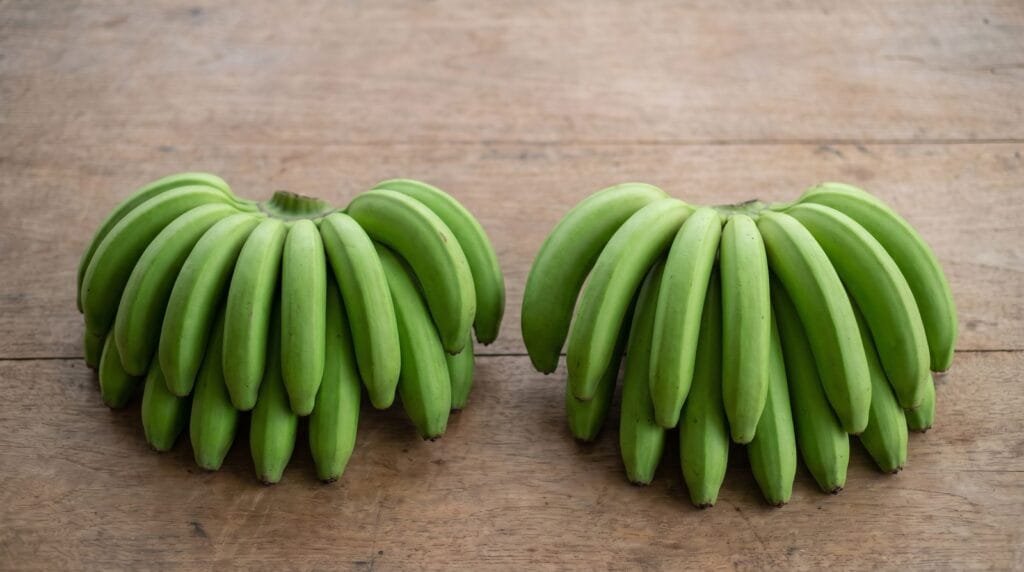
Ask for “bananas” in Kuala Lumpur and in a supermarket buying office and you will be talking about two different fruits. The pisang berangan vs Cavendish distinction is not a matter of preference or grade — they are different cultivars serving different trades, and confusing them is how an enquiry ends with quotations nobody can compare.
Pisang berangan vs Cavendish: what each one is for
Berangan is a dessert banana Malaysians eat. Along with pisang emas it is what locals reach for fresh: aromatic, denser, the kind of fruit rarely seen in a Western supermarket. It is grown across the peninsula, harvested continuously through the year, and it is a domestic product first.
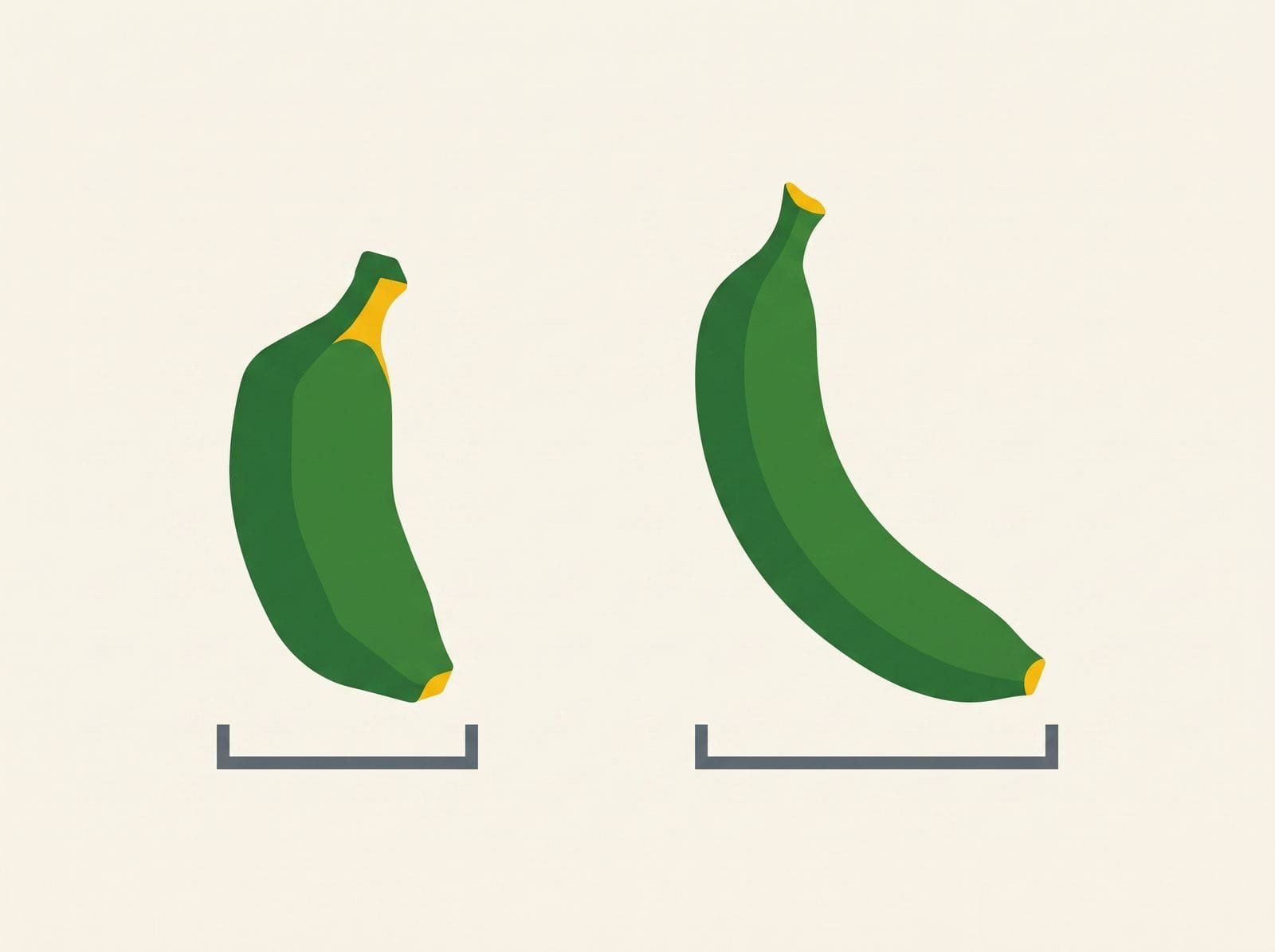
Cavendish is the export banana. It comes off large farms, it is graded by finger length, it is packed into standardised cartons and it is ripened on a schedule at the destination. Almost everything crossing a border as fresh banana is Cavendish, and every export standard in the trade is written around it.
Neither is better. They are optimised for different jobs, and the job Cavendish is optimised for is travelling and arriving predictably.
Why the imported fruit is nearly always Cavendish
Three reasons, and none of them is flavour.
- Gradability. Cavendish is bought and sold against a finger length and a grade, which is what makes a written specification possible in the first place. A trade in which each side can measure the same thing is a trade that can run on contracts rather than on trust.
- Standards exist for it. The international marketing standards used across the banana trade are built around Cavendish dimensions and defect tolerances — the fields covered in our guide to Cavendish banana grades and sizes.
- Ripening control. Cavendish ships green and is ripened to a chosen colour stage at destination, which is what lets a buyer put fruit on a shelf on a chosen date.
A local dessert variety can be excellent and still be a poor export product, simply because it was never selected for a 2,000-kilometre journey and a ripening room at the other end.
The handling difference behind the taste difference
Part of why local fruit tastes the way it does is that it barely travels. A dessert banana picked nearby and sold within days can be cut closer to ripe, because it does not need days in a container to survive. Export Cavendish cannot: it is cut green, held green through the voyage, and ripened deliberately at the far end.
That is a trade-off rather than a defect. Controlled ripening is what lets a supermarket put fruit on a shelf at a chosen colour on a chosen date, at a scale no short local chain could serve. But it does mean the two products reach the shopper by genuinely different routes, and an importer comparing them on eating quality alone is comparing the end of two different supply chains.
Where this bites in an enquiry
A Malaysian buyer thinking in local terms and a Vietnamese supplier thinking in export terms can exchange several emails without noticing they are discussing different fruit. The symptoms are recognisable:
- Quotations that differ by more than they should, because one is for a local dessert variety and one is for graded export Cavendish
- A sample that arrives visibly different from what the buyer pictured
- A specification with no finger length in it, because in the local trade nobody quotes one
The fix is one line. Name the cultivar and give a finger length range. “Cavendish, 17 to 20 cm” removes the ambiguity that “banana” cannot.
There is one thing the two cultivars have in common, and it is not good news. The two main cultivars planted in Malaysia are Berangan and Cavendish, and more than half of that planted area is highly susceptible to Fusarium wilt.
That is worth knowing on both sides of the counter. It explains why Malaysian planted area has been contracting, and it is a reminder that choosing a variety for the domestic market does not sidestep the disease question — it only changes which block is exposed.
Working with Dragon Hub
Dragon Hub packs and exports Cavendish bananas to supermarket and wholesale buyers across Asia and the Middle East, graded to a stated finger length rather than to a house description. The full specification is on the Cavendish banana page, alongside the rest of our product range. If your programme genuinely needs a local dessert variety rather than Cavendish, say so at enquiry and we will tell you honestly whether it travels.
Frequently asked questions
What is the difference between pisang berangan and Cavendish?
Berangan is an aromatic dessert banana grown and eaten in Malaysia, denser and rarely seen in Western supermarkets. Cavendish is the commercial export banana: longer fingers, graded by length, packed to standard cartons and ripened at destination. They serve different trades rather than different price points.
Why does Malaysia import Cavendish rather than local varieties?
Because Cavendish is what the export trade is built around. It can be graded by finger length, international marketing standards define its dimensions and defect tolerances, and it ships green for controlled ripening at destination. Local dessert varieties are excellent fresh but were never selected to travel.
Can Berangan be exported?
It moves in small volumes, but it is a domestic-market fruit by design. The export trade runs on graded, standardised, ripening-controlled Cavendish, and a variety without an established grading standard is difficult to specify, compare and claim against across a border.
What should I write in an enquiry to avoid confusion?
Name the cultivar and the finger length: “Cavendish, 17 to 20 cm” rather than “bananas”. Add grade, class, carton weight and tolerance. Without a cultivar and a length, quotations from different suppliers describe different products and cannot be compared on price.
Sources
- Malaysian fruit guide — banana: local dessert, frying and kuih cultivars, year-round harvest, and Cavendish as the export variety
- FAMA Malaysia: Berangan and Cavendish as the main planted cultivars and their Fusarium susceptibility
