
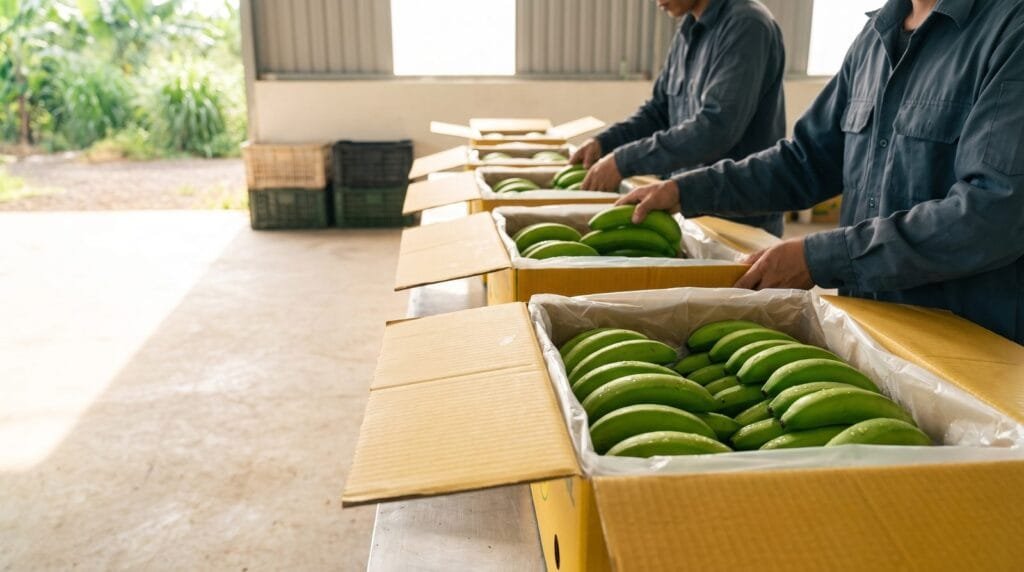
If you are looking for a Vietnam banana supplier in Malaysia, start from a fact most sourcing pages leave out: you are almost certainly buying Vietnamese bananas already. Vietnam is not trying to enter this market. It holds it.
That changes what a page like this should be about. Not why Vietnam, but how to buy from Vietnam better than your current arrangement.
Vietnam banana supplier Malaysia: the market as it stands
Malaysia imported about 30.6 million kilograms of bananas worth roughly 15.3 million US dollars in 2024. The split by origin:
| Origin | Volume 2024 | Share of volume | Average import value |
|---|---|---|---|
| Vietnam | 21.6 million kg | 70.4 % | 0.52 USD/kg |
| Philippines | 3.9 million kg | 12.8 % | 0.57 USD/kg |
| Indonesia | 2.8 million kg | 9.2 % | 0.34 USD/kg |
| Thailand | 2.0 million kg | 6.5 % | 0.35 USD/kg |
| Ecuador | 0.1 million kg | 0.4 % | 0.65 USD/kg |
Vietnam supplies more than five times what the Philippines does here, at a slightly lower average value. Read the last column carefully though: Vietnamese fruit sits above Indonesian and Thai fruit on value and just below Philippine fruit. This is not the bottom of the market, and a Vietnamese quotation priced like Indonesian fruit should raise a question rather than a purchase order.
For context on the wider price picture, wholesale bananas in Malaysia averaged about 0.67 US dollars per kilogram in 2026, up from 0.57 the year before, with sampled import transactions in February 2026 spread between 0.42 and 1.22 dollars. That spread is two segments sharing one customs code, and they need different grades.
Why Malaysia imports at all
On paper Malaysia does not need to. Its banana self-sufficiency ratio ran at 100.1 % between 2016 and 2020. The detail underneath is more interesting.
National production peaked at 350,493 tonnes in 2017 and fell to 312,968 tonnes by 2020. Planted area dropped harder, from 34,894 hectares in 2017 to 26,079 hectares in 2019 — roughly a quarter of the area gone in two years. Johor alone accounts for about 32 % of what remains.
The reason matters to anyone planning supply: the two main cultivars planted in Malaysia are Berangan and Cavendish, and more than half of that planted area is highly susceptible to Fusarium wilt. A soil disease that cannot be cleaned out of infected land does not produce a gradual decline; it removes blocks permanently.
So the 100 % figure describes a balance that is being held while the domestic base contracts. Imports are not filling a gap that opened once. They are covering a base that keeps moving, which is precisely why continuity of supply is worth more here than the last cent on a quotation.

Berangan is not what you are importing
Worth stating plainly, because it causes crossed wires in enquiries. Malaysian consumers know bananas as Berangan and Pisang Emas — shorter, denser fruit sold for eating fresh. The imported trade is Cavendish: longer fingers, graded by length, packed for supermarket programmes and ripened to a colour stage.
If your enquiry says “banana” without a variety and a finger length, you will get quotations for different products from different suppliers and no way to compare them. Say Cavendish, and say the length.
Paperwork: MAQIS, and the form that sets your duty
Two things sit on the Malaysian side of the transaction and one on the Vietnamese side.
- A MAQIS phytosanitary import permit, obtained before the cargo arrives. Fresh produce falls under the Malaysian Quarantine and Inspection Services, which runs risk-based screening at entry points such as Port Klang and may sample and lab-test a consignment.
- Active importer registration in the Malaysian food import system, plus labelling in Bahasa Malaysia or English showing the product, net content, country of origin, date marking and importer details.
- A phytosanitary certificate issued by Vietnam’s agriculture ministry, travelling with the shipment.
On duty, ask your supplier for the ASEAN certificate of origin, Form D, under the ATIGA agreement. Vietnam issues several origin forms and the one you receive decides the preference your customs authority applies — so name it at booking rather than after the vessel sails. The full document set is in our guide to how to import bananas from Vietnam.
The short voyage is the real advantage
Malaysia is close to Vietnam, and on bananas proximity is not a freight argument but a biological one. A banana leaves the farm green and spends the voyage refusing to ripen; the days it will stay green are finite, and a shorter lane spends fewer of them.
That unspent margin can be taken two ways, and a good supplier will ask you which you want. Either the fruit is cut fuller, which eats better after ripening, or the margin is kept as insurance against a delayed vessel or a slow clearance. Origins shipping from the other side of the world rarely have that choice: they need lean fruit and they need everything on time.
It also means a Malaysian buyer should be sceptical of a supplier who quotes the same cutting maturity for Port Klang as for a Gulf or European lane. The routes are not comparable and the cut should not be identical.
What to send us for a quote
- Finger length and grade, and your defect and size tolerance in writing
- Carton weight, and whether the print is yours, neutral or ours
- Whether the pack is retail-ready or for repacking locally
- Port of discharge, and total days from our packhouse to your ripening room
- Whether you ripen locally, and the colour stage you sell at
- Volume per shipment and frequency across the year, including festive peaks
- Form D, or whichever origin certificate your broker wants
- Incoterm and payment instrument
Working with Dragon Hub
Dragon Hub is a Vietnam banana supplier Malaysia buyers can deal with directly: we pack and export Cavendish bananas to supermarket and wholesale buyers across Asia and the Middle East, Malaysia included. We quote against a written specification rather than a market average, and we will say where we would push back before a container is booked rather than after it arrives. The full specification is on the Cavendish banana page, alongside the rest of our product range. Send the list above and you will get a specific answer.
Frequently asked questions
Where does Malaysia import its bananas from?
Mostly Vietnam. Of about 30.6 million kilograms imported in 2024, Vietnam supplied 21.6 million kilograms, or 70.4 % of the volume. The Philippines followed at 12.8 %, then Indonesia at 9.2 % and Thailand at 6.5 %, with Ecuador under half a per cent.
Why does Malaysia import bananas when it grows its own?
Its self-sufficiency ratio was 100.1 % between 2016 and 2020, but the domestic base is contracting: production fell from 350,493 tonnes in 2017 to 312,968 by 2020, and planted area from 34,894 hectares to 26,079 in two years. More than half the planted area is highly susceptible to Fusarium wilt.
What permits are needed to import bananas into Malaysia?
A MAQIS phytosanitary import permit obtained before arrival, active importer registration, and compliant labelling in Bahasa Malaysia or English. The shipment also carries a phytosanitary certificate from the exporting country. MAQIS screens consignments on a risk basis at entry points such as Port Klang.
Is imported banana the same variety Malaysians usually eat?
No. Local favourites are Berangan and Pisang Emas, shorter and denser fruit for eating fresh. The imported trade is Cavendish, graded by finger length and packed for supermarket programmes. An enquiry that does not name the variety and the length will attract quotations for different products.
Which certificate of origin applies to Vietnam to Malaysia shipments?
Form D, issued under the ASEAN Trade in Goods Agreement. Vietnam issues a different origin form for each trade agreement and the form you receive determines the tariff preference available, so specify it before booking. Confirm the applicable line with your own customs broker.
Sources
- Malaysia fresh banana market overview: import volume and value 2022–2024, origin shares, sampled import and wholesale prices
- FAMA Malaysia: national production and planted area, self-sufficiency ratio, cultivars and Fusarium susceptibility
- Importing food into Malaysia: MAQIS permit, importer registration, labelling and entry-point inspection
