
Of 3,825 consignments of imported fruit and vegetables sampled in Singapore between April and December 2019, 491 failed. That is about 12.8 %, and it was the highest non-compliance rate of any food category that year.
Roughly one consignment in eight. If you import fresh produce into Singapore, that is the number behind the phrase hold and test, and it is worth understanding before a container of yours is the one being held.
What hold and test actually means
SFA inspects imported fruit and vegetables and samples them for pesticide residue testing. A consignment placed on hold and test cannot be sold or distributed until laboratory results are released and the results are compliant.
Read that carefully. The cargo has cleared the vessel, it is on the ground, it is yours — and it is frozen. Average release times run one to two days for airfreight and one to three days for surface shipments, and a test adds to that. For bananas, those are days coming off the shelf life you were planning to sell into.
Inspections themselves carry no fee. The cost is time, and on perishables time is the expensive part.
What happens when it fails
A consignment over the residue limits is rejected and destroyed under SFA supervision. Not returned, not downgraded, not sold into a secondary channel — destroyed, with the agency watching.
The importer is then expected to resolve the problem with the overseas supplier. There is an appeal route to SFA’s import and export department for detained or rejected product, but the baseline outcome for a residue failure is total loss of the consignment.
SFA’s own guidance also states that a source, exporter or importer may be suspended for non-compliance. So the downside is not bounded by the value of one container: it can reach the relationship and the market access behind it.
What a three-day delay costs a banana container
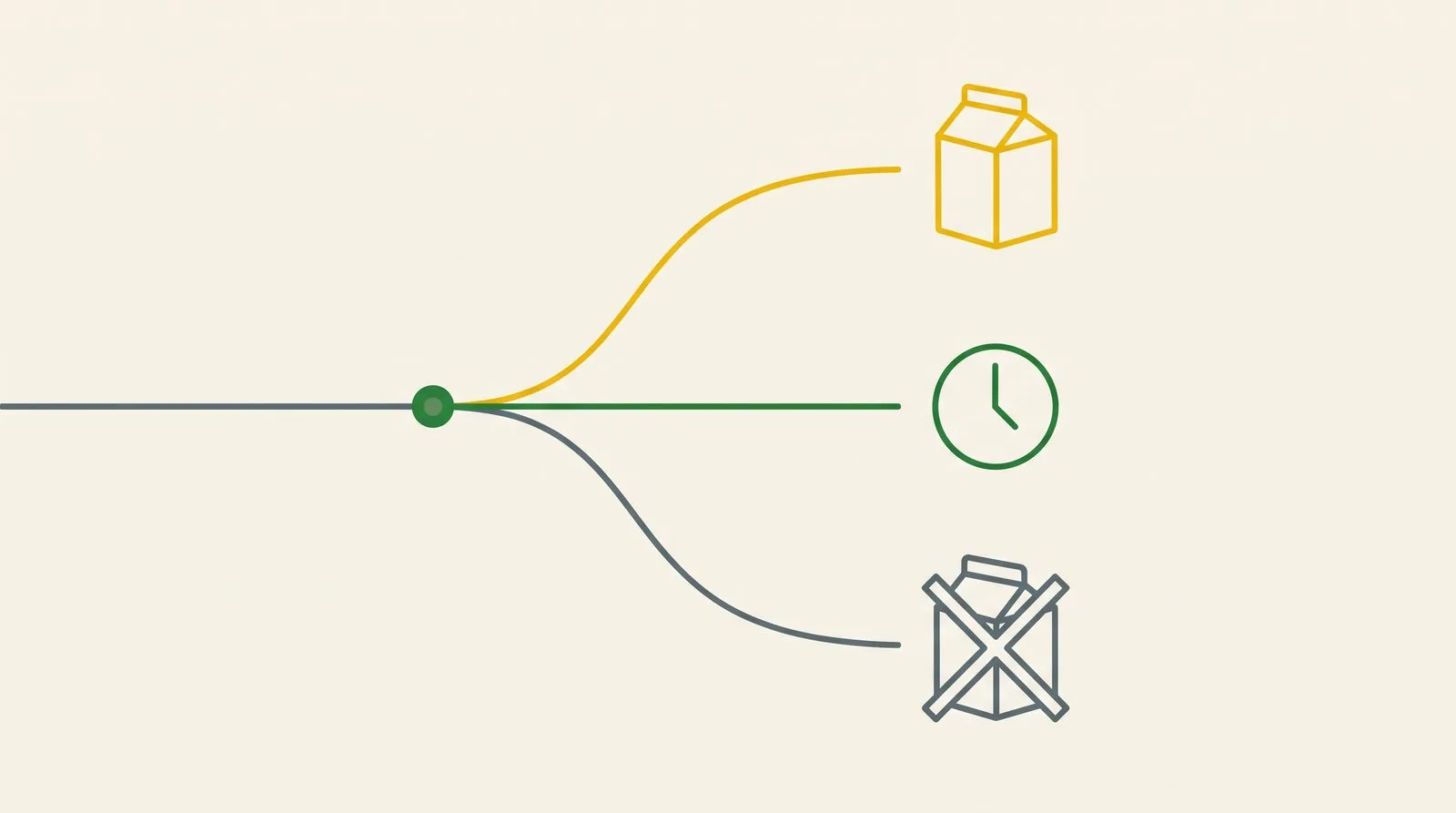
For most imported goods a detention is an inconvenience with a storage bill attached. For bananas it is a different kind of cost, because the cargo is running its own clock the whole time.
A banana leaves the farm green and the days it will stay green are finite. A voyage from Vietnam spends only a few of them, which is the advantage of a short lane — but a detention spends them too, and it spends them at the worst possible moment, after the fruit has already used up its transit and is waiting to be ripened on a schedule somebody has committed to a retailer.
Two consequences a buyer can plan for. The container has to stay powered and at setpoint through the release window, which is an arrangement with the terminal rather than something that happens by default. And the fruit should be cut with enough margin that three days of waiting does not land it in the ripening room already turning.
Why produce fails: the positive list
Most failures are not exotic. They come from the structure of the rules.
Residue limits for fresh produce come from the Ninth Schedule of the Food Regulations, and where the schedule sets no limit for a substance, the Codex MRL applies. This is a positive list: the question is not whether a residue is comfortably under a generous ceiling, but whether the substance appears in the schedule at all.
A grower using a product that is perfectly normal in Vietnam, perfectly legal there, and simply absent from the Ninth Schedule can put a container into the 12.8 %. Nobody involved has done anything careless. The specification just never named the list.
What a buyer can actually control
Four things, and the first is worth more than the other three together.
- Agree the residue programme in writing, referenced to the Ninth Schedule with Codex as the fallback. Not “compliant with Singapore requirements” — the actual list, named. Agree it before the fruit is grown, because that is when the decisions are made.
- Ask whether your supplier has tested against that list, and at whose laboratory. A supplier who has never seen the schedule is not a supplier who can hold it.
- Plan the cold chain through the release window, as above — the regime and the reasons behind each figure are in our note on reefer container settings for bananas.
- Keep green life in reserve. Fruit cut with margin survives a three-day hold; fruit cut full does not. Our note on green life explains how that margin is created and lost.
The cartons carry the traceability
Fresh fruit and vegetables need no overseas facility registration for Singapore, which means there is no approved-establishment list standing between a packhouse and the market. The traceability requirement lands on the box instead: external cartons must be tagged or labelled with the country of origin and the packing plant.
When a consignment is held, that label is what ties the fruit back to where it was packed. It is also what lets you and your supplier find the block responsible rather than arguing about the container. Tell your supplier before the print run, not after.
A note on how to read the 12.8 %
Two honest caveats. The figure covers all imported fruit and vegetables rather than bananas specifically, and failures in that programme included microbiological and chemical limits as well as pesticide residues. Bananas are a thick-skinned, mostly unprocessed commodity and are unlikely to sit at the category average.
But the direction is not in doubt, and neither is the enforcement posture: every consignment inspected, samples taken, failures destroyed. A supplier who treats that as a formality has not read it.
Working with Dragon Hub
Dragon Hub packs and exports Cavendish bananas to supermarket and wholesale buyers across Asia and the Middle East. On a Singapore programme we would rather be handed the residue list and asked what we can hold to than be told the requirement is to be compliant. Where we cannot meet something, we would rather say so before a container is on the water. The full specification is on the Cavendish banana page, alongside the rest of our product range.
Frequently asked questions
What does hold and test mean for an imported consignment?
The consignment cannot be sold or distributed until laboratory results are released and found compliant. SFA inspects imported fruit and vegetables and samples them for residue testing. Release times average one to two days for airfreight and one to three for surface shipments, with testing adding to that.
How often do fruit and vegetable consignments fail in Singapore?
In an official sampling programme covering April to December 2019, 491 of 3,825 consignments of imported fruit and vegetables failed — about 12.8 %, the highest non-compliance rate of any food category that year. The figure spans all produce and all limit types, not bananas or pesticides alone.
What happens to a consignment that exceeds residue limits?
It is rejected and destroyed under SFA supervision, and the importer is expected to resolve the problem with the overseas supplier. An appeal route exists through SFA’s import and export department, and SFA states that a source, exporter or importer may be suspended for non-compliance.
Which residue limits apply to fresh fruit in Singapore?
Those in the Ninth Schedule of the Food Regulations, with the Codex MRL applying where the schedule sets no limit. It operates as a positive list, so a substance absent from the schedule is a question rather than an automatic pass, which is why the programme should be named in the specification.
Sources
- Food Safety News: 491 of 3,825 consignments of imported fruit and vegetables failed sampling, April to December 2019
- Singapore FAIRS country report: hold and test, release times, destruction of non-compliant consignments, Ninth Schedule and Codex limits, carton labelling, no facility registration for produce
- Singapore Food Agency: inspection and sampling on arrival, hold and test, and suspension of a source, exporter or importer for non-compliance
