
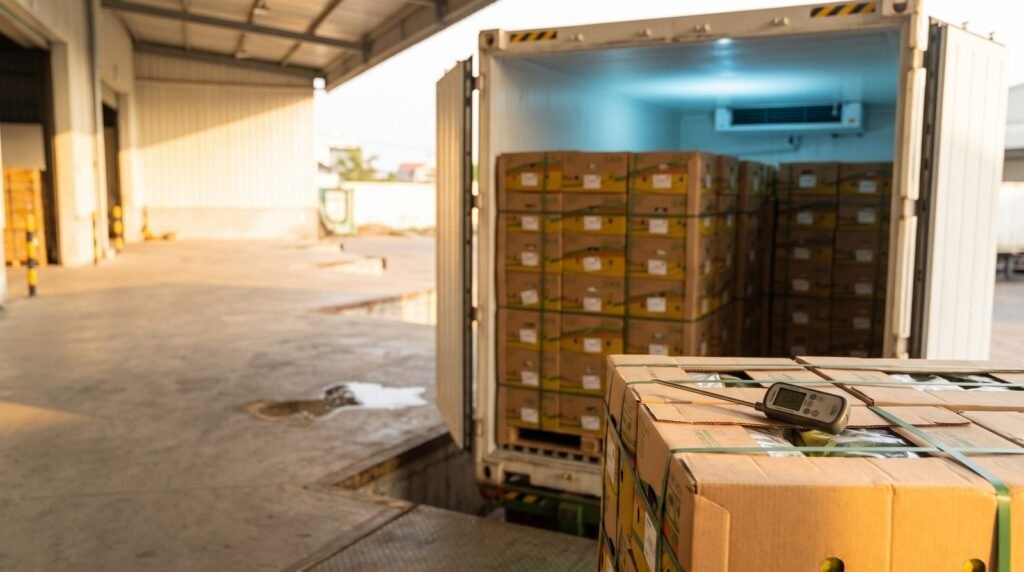
The doors open at your yard and a decision has to be made before anything moves. A banana quality inspection on arrival is not a formality. It is the last moment at which the load can be described accurately by someone who is neither the carrier nor the supplier.
Done in the wrong order it proves very little. This is the order that holds up: the machine first, pulp temperature second, the fruit third, and the paperwork while the container is still on the chassis.
Read the machine before you read the fruit
The reefer unit keeps its own record. Its data logger stores the pre-trip inspection result, the trip start, alarm history and two separate air temperatures. Ask for that download before a single pallet comes off.
The two air readings are not interchangeable, and confusing them is the most common way a good claim gets argued away. A carrier undertakes to control the delivery air. Return air is measured close to the machinery, and it spikes during defrost in a way that looks alarming on a chart and means nothing to the cargo.
Neither reading is the temperature of the fruit. Logged air temperatures do not record cargo temperature, and a conclusion drawn from the air trace alone will not survive a surveyor. Cargo temperature can only be approximated, from treatment probes or from loggers the shipper placed inside the stow. Our note on reefer container settings for bananas covers the regime the chart should show.
Pulp temperature, taken before anything is unloaded
Pulp readings describe the load as it travelled only if they are taken while it is still stowed. Once cartons are standing on a dock in ambient air, every reading afterwards is a reading of your warehouse.
Take at least three pulp temperatures across the lot, and more if part of it looks abnormally cold or abnormally warm. Pre-cool the probe before the first reading, and record each one to the nearest whole degree along with where in the load it came from.
If the shipper placed a recorder on the load and you cannot find it, document the absence at arrival rather than later. The same goes for the pattern on the unit download: supply air swinging across a wide band while return air sits almost flat points at the machine or at air circulation inside the stow, not at the fruit.
Banana quality inspection on arrival: how much to open
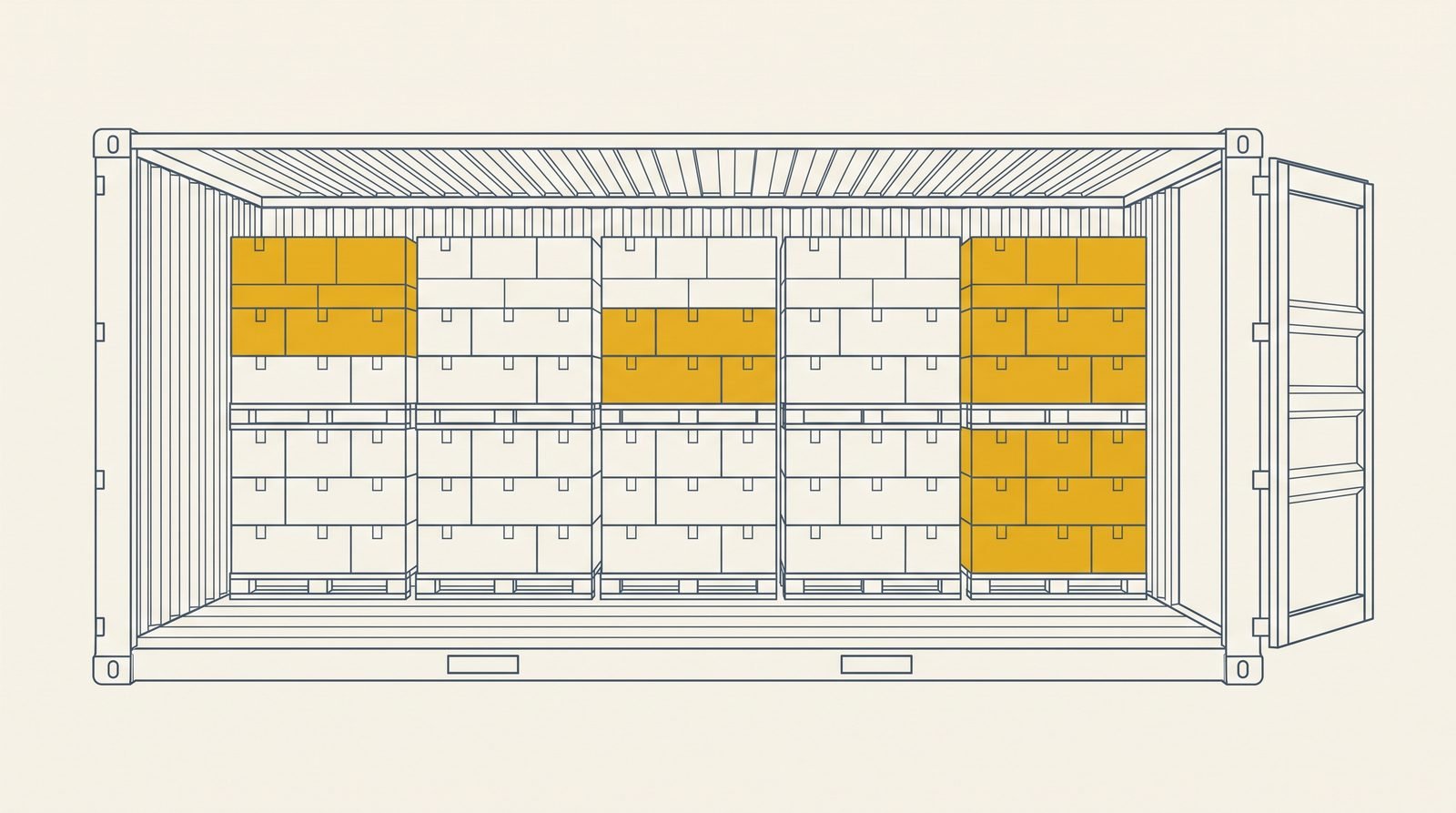
Opening three cartons at the door and calling it a load is the error that makes most arrival reports worthless. The door end is the easiest to reach and the least representative: it runs warmest or coldest and it was loaded last.
The published inspection practice is a workable floor:
- Examine at least 1% of the lot.
- A lot of fewer than 300 cartons still gets at least three samples.
- Where a carton holds 50 or more fingers, a sample unit is at least 50 fingers; smaller packs are examined whole.
- Give every part of the lot equal attention, including layers that are awkward to reach. If part of the stow cannot be reached, the finding covers only the part that was.
- Take extra samples whenever two opened cartons disagree on quality, condition or size.
Record which position each sample came from — door, middle, nose, top tier, bottom tier. A defect that clusters at one end is a cold chain or stowage question. The same defect spread evenly through the load is a packing house question.
What the fruit itself should tell you
Colour is read on the familiar seven-stage scale, from dark green through yellow with green tips to yellow flecked with brown. For a load that was meant to arrive green and go into a ripening programme, anything past the second stage is a schedule problem rather than a quality defect, and the two should not be reported as the same thing. The stages and what each one commits you to are set out in our guide to the banana ripening colour index.
Alongside colour, note the things a specification is actually written against: finger length class, fullness of the fingers, and whether cartons are well filled, fairly well filled or slack. Slack fill is measurable and should be measured, not described.
Chilling injury, bruising and crown rot look nothing alike
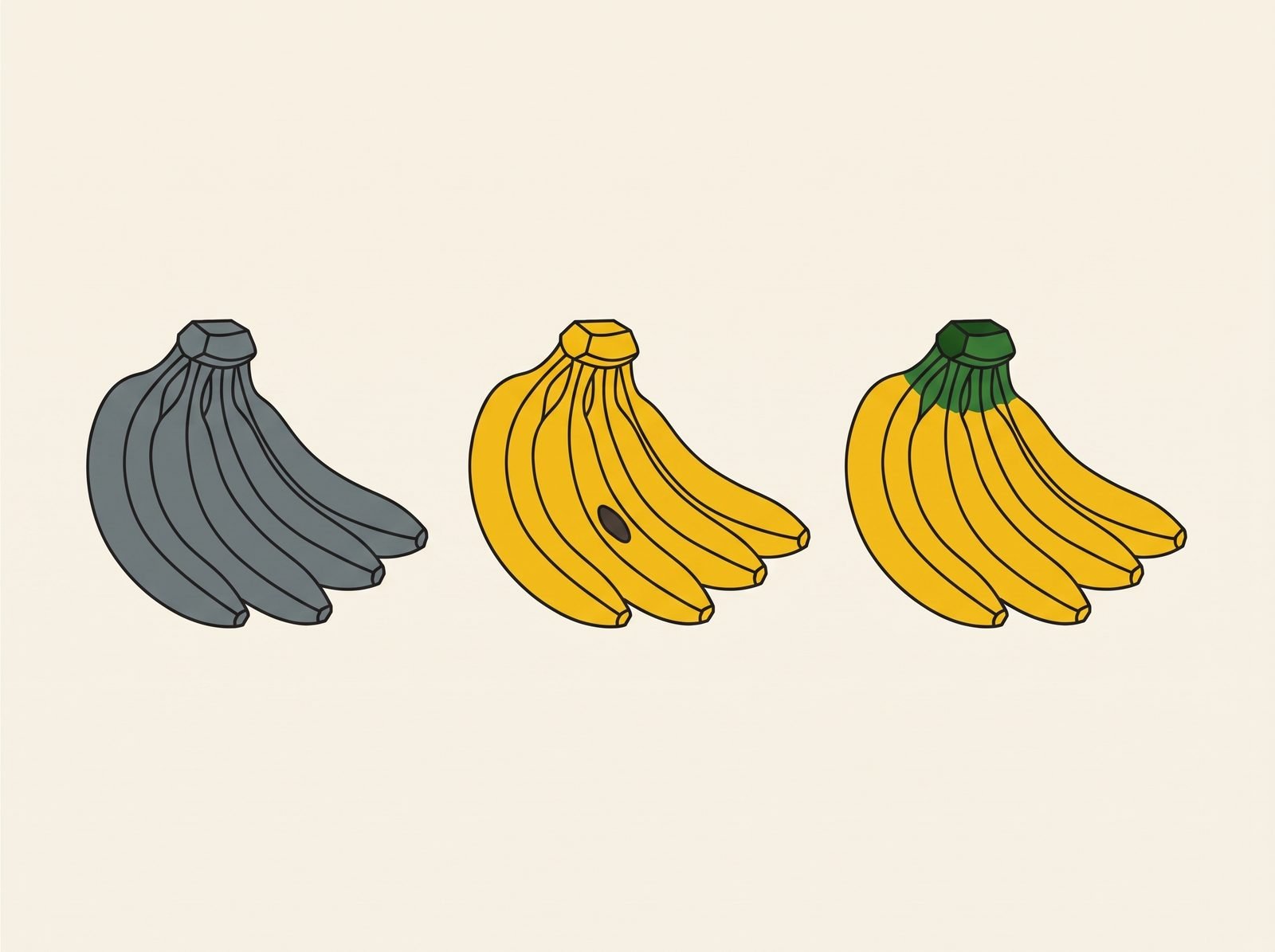
Most disputes come from naming the defect wrongly, because the name decides who pays. Four of them account for almost everything you will see on a banana container.
- Chilling injury — peel damage from low but non-freezing temperature. Roughly twelve hours below 45 °F (about 7 °C) in still air is enough to affect marketability. It reads as a dull, greyed peel and underlying vascular browning, and it has to be described rather than simply named.
- Black rot at the neck — pliable, black, irregular discolouration where the finger joins the crown, usually with little surface mould. Scored finger by finger.
- Crown rot — black rot confined to the crown of the cluster, scored as a percentage of that cluster’s fingers. A packing house problem, not a reefer problem.
- Bruising — scored when it affects appearance, shipping or edible quality. Note the ripeness of the affected fruit and where in the load it sat; bruising on soft fruit at the bottom tier tells a different story from bruising on green fruit at the top.
Paperwork, while the container is still there
If the load may be claimed, the window for evidence closes when the container leaves. Note the reason for receiving under protest on the bill of lading itself, not in a later email.
Keep the unit download and the pre-trip inspection record, the location and activation time of every portable recorder, the seal numbers as found, and the written confirmation of carriage conditions given before loading. An independent survey carries weight that your own photographs do not, and it has to be requested while the fruit is still in the condition being described. Which of these costs falls on you depends on the term you bought on, which is the subject of our note on who pays when the reefer fails.
Working with Dragon Hub
Dragon Hub packs and exports Cavendish bananas to supermarket and wholesale buyers across Asia and the Middle East. We would rather agree the inspection method, the sampling positions and the defect names with a buyer before the first container sails than argue about them afterwards, and we will send the loading-day pulp readings and setpoint confirmation with the documents. Specifications are on our product pages, and we will quote against your inspection standard rather than our own.
Frequently asked questions
How many cartons should be opened in a banana quality inspection on arrival?
At least 1% of the lot, and never fewer than three samples even on a small consignment. Where cartons hold 50 or more fingers, each sample should cover at least 50 fingers. Spread the samples across door, middle and nose positions and across tiers, and open more as soon as two cartons disagree.
Is the reefer chart enough to prove a temperature claim?
No. The logger records delivery and return air, not fruit temperature, and firm conclusions cannot be drawn from the air trace alone. Return air also spikes normally during defrost. A claim needs pulp readings, the unit download, the pre-trip record and the agreed carriage conditions together.
What is the difference between crown rot and chilling injury on arrival?
Crown rot is black rot confined to the cut crown of a cluster and originates in the packing house, so it is scored as a share of that cluster’s fingers. Chilling injury is peel damage from cold, shows as a dull grey cast with vascular browning, and follows roughly twelve hours below 45 °F in still air.
Sources
- USDA AMS — Banana Inspection Instructions: sampling rates and sample units, pulp temperature procedure, colour stages, and the definitions and scoring of crown rot, black rot, chilling injury, bruising and discolouration
- West of England P&I — The Carriage of Reefer Containers: delivery air as the controlled reading, return air and defrost, what the data logger holds, and the evidence to preserve
- Fruit and Vegetable Dispute Resolution Corporation — Importance of Documenting Temperatures: pulping before unloading, missing recorders, receiving under protest, and reading supply against return air on the unit download
