
A purchase order that says “deliver at colour stage 4” sounds precise. It is not, and the reason is worth two minutes of your time: the banana ripening stages colour index is not standardised. The descriptions are stable across the trade. The numbers attached to them are not.
The banana ripening stages colour index is not one scale
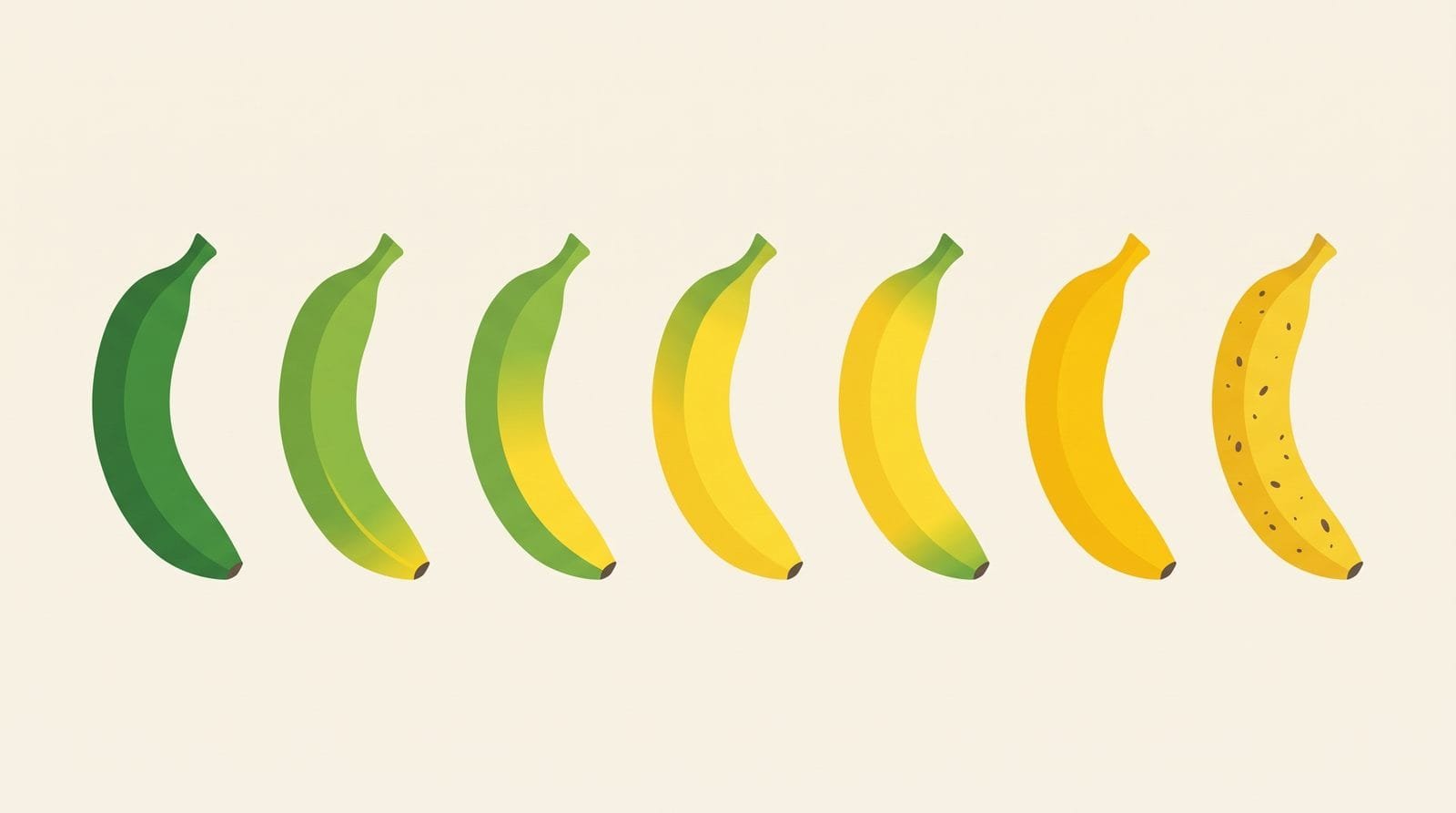
Put two widely used charts side by side. Dole’s commercial chart runs: all green, light green, half green and half yellow, more yellow than green, yellow with green tips, full yellow, yellow flecked with brown. The visual aid published by the US Department of Agriculture runs: green, light green breaking toward yellow, more yellow than green, greenish yellow with green tips, yellow, yellow flecked with brown.
| Description | Dole chart | USDA visual aid |
|---|---|---|
| More yellow than green | 4 | 3 |
| Yellow with green tips | 5 | 4 |
| Full yellow | 6 | 5 |
| Yellow flecked with brown | 7 | 6 |
The same fruit sits a full stage apart depending on whose chart is open. A container specified at stage 4 and delivered at stage 4 can still be an argument, and both sides will be holding a chart that proves them right.
The fix costs one line in the contract: name the chart, or describe the colour. “Yellow with green tips” is unambiguous in any language and survives translation into every language your chain uses. “Stage 5” survives nothing, and it is the kind of ambiguity that only surfaces once a container is already on the water and a claim is being drafted.
What each stage is for
Once the chart is agreed, the stages do real work, because each one suits a different point in the chain.
- All green. How fruit ships. Nothing has started yet, and the clock that is running is green life, not shelf life.
- Light green. The first change after ethylene. Still too early to move to a shop.
- Half green, half yellow. The usual outturn point from a ripening room to a distribution centre, because the fruit finishes on the way.
- More yellow than green. Retail display in a fast-turning store.
- Yellow with green tips. What most shoppers actually buy.
- Full yellow. Firm, best flavour, shortest time left.
- Yellow flecked with brown. Sweetest, and past retail for most programmes.
Note how narrow the commercial window is: from outturn to too-late is four stages and a handful of days. That is why the colour stage is not a quality grade but a delivery schedule — the number is a date in disguise.
How the fruit gets there
Ripening is induced, not awaited. The published conditions are 100 to 150 ppm ethylene for 24 to 48 hours at 15 to 20 °C with relative humidity of 90 to 95 %, after which the fruit carries on through the stages on its own.
Within that range the room operator has a real choice. A warmer, faster schedule reaches colour quickly and suits a tight delivery; a cooler, slower one gives better eating quality and more life on the shelf. Both land on the same colour number, which is another reason the number alone does not describe the fruit you receive.
One hard limit: the fruit has to arrive undamaged for any of this to work. Bananas held below about 13 °C in transit suffer chilling injury and then will not ripen properly at all — they stay hard or go muddy yellow, and the failure surfaces in the ripening room rather than at the container door. The transit regime that protects this is in our note on reefer container settings for bananas.
What to write in the specification
- The chart you are both working to, by name — or a written colour description instead of a number
- The stage at outturn from the ripening room, and the stage you expect on the shop floor
- Whether you ripen at destination or need the fruit ripened elsewhere
- Days from the ripening room to your first delivery point
- Finger length, grade and class, which are a separate axis entirely — see Cavendish banana grades and sizes
Working with Dragon Hub
Dragon Hub packs and exports Cavendish bananas to supermarket and wholesale buyers across Asia and the Middle East. We ship green, because the colour stage your customer sees should be a decision you make on a date you choose rather than something that happens on the water. The full specification is on the Cavendish banana page, alongside the rest of our product range.
Frequently asked questions
What are the 7 banana ripening stages?
From green through to yellow flecked with brown: all green, light green, half green and half yellow, more yellow than green, yellow with green tips, full yellow, yellow flecked with brown. The descriptions are consistent across the trade; the numbers attached to them are not, so agree the chart before using stage numbers in a contract.
Why do banana colour charts use different numbers?
Because the charts were developed separately by different companies and agencies. On Dole’s chart, “more yellow than green” is stage 4; on the USDA visual aid the same description is stage 3. A shipment specified and delivered at the same number can therefore be a full stage apart.
How are bananas ripened to a specific colour stage?
With ethylene at 100 to 150 ppm for 24 to 48 hours at 15 to 20 degrees Celsius and 90 to 95 % humidity, after which the fruit progresses on its own. A warmer schedule reaches colour faster; a cooler one gives better eating quality and more shelf life at the same colour number.
At what stage should bananas leave the ripening room?
Commonly at half green and half yellow, so the fruit finishes during distribution and reaches the shop floor at more yellow than green. The workable window from outturn to past-retail is only about four stages, which is why the colour stage functions as a delivery schedule rather than a quality grade.
Sources
- Dole banana colour chart: stage numbering and the commercial use of each stage
- USDA banana ripening visual aid: stage descriptions used for inspection
- UC Davis Postharvest — Banana: ethylene concentration, duration, ripening temperature and humidity
