
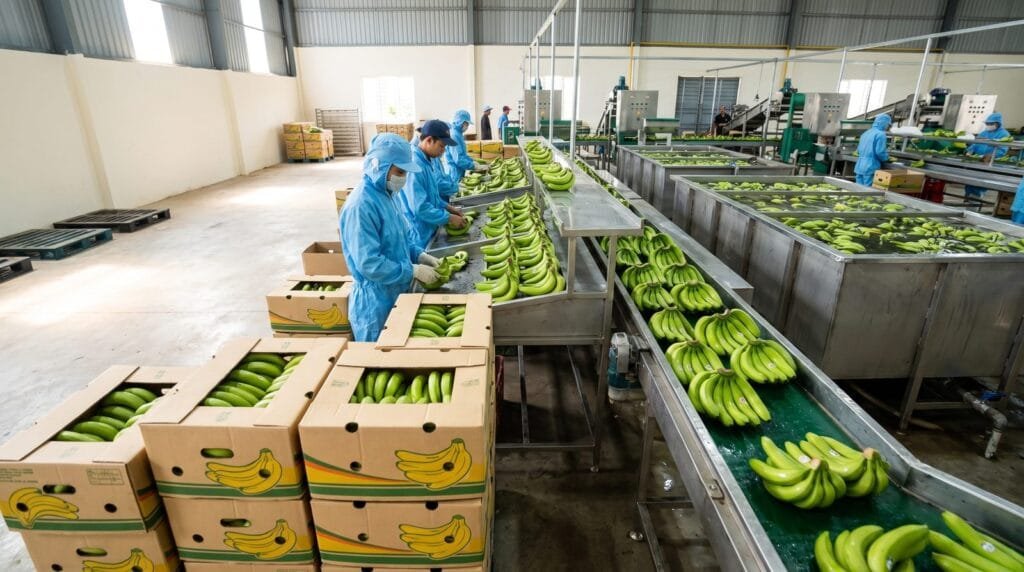
Exporting bananas to China is the largest single lane in the Vietnamese banana trade — China takes about two thirds of the country’s banana export value — and since 2022 it has run on a formal protocol rather than on informal border trade. The practical effect for a buyer is simple: a Vietnamese banana shipment into China is only legal if the fruit comes from a registered orchard and a registered packing house, and if it enters through a port that is approved for it.
If you are importing, those registrations are not your supplier’s private paperwork. They are the thing your customs clearance depends on, and they are worth checking yourself rather than taking on trust, because the consequence of a wrong one lands at the border with a perishable cargo behind it.
Exporting bananas to China starts with two codes, not one
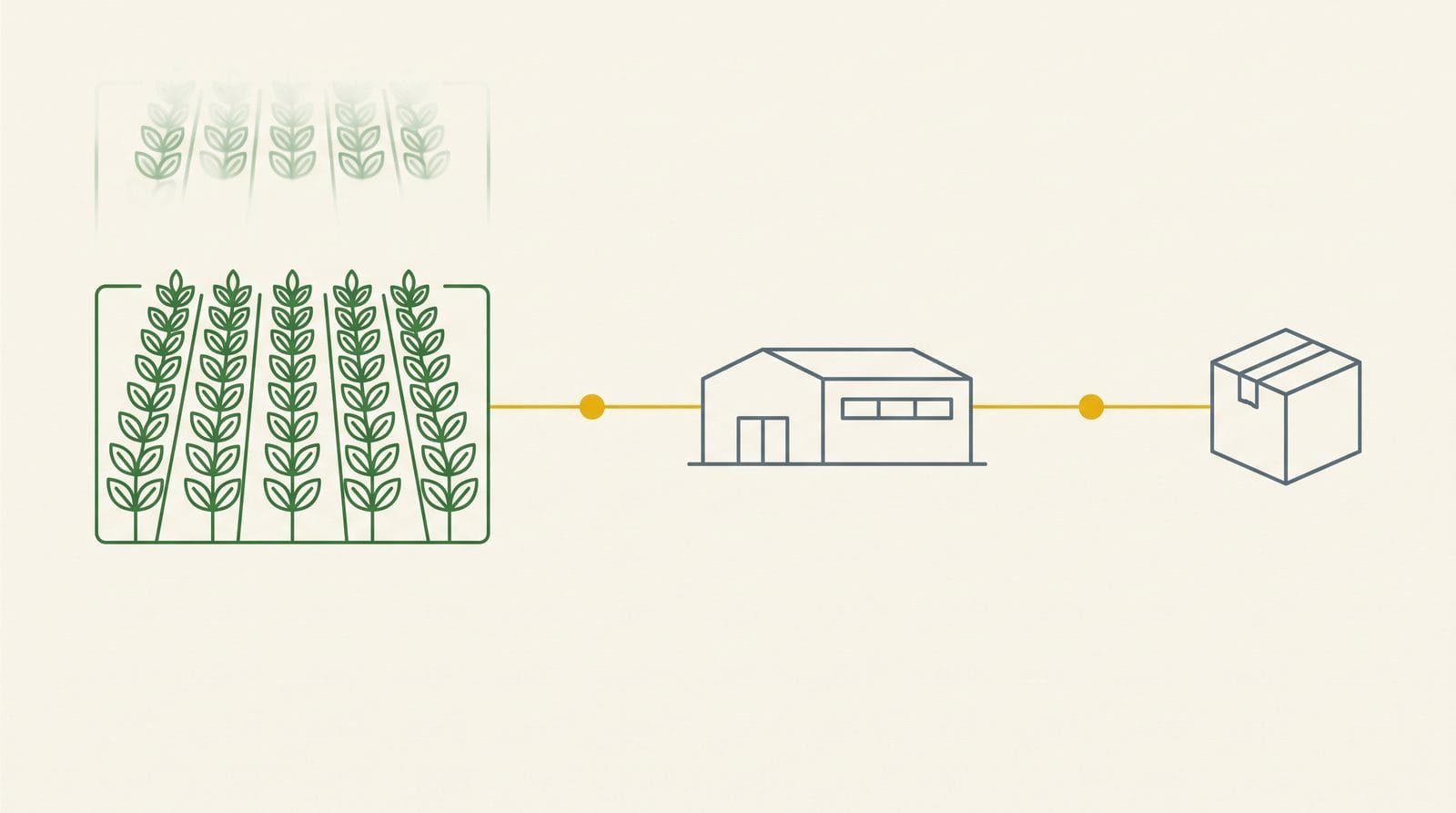
Vietnamese exporters hold two separate registrations, and they answer two different questions.
- Growing area code — where the fruit was grown. It attaches to a defined orchard area, not to a company.
- Packing house code — where the fruit was received, graded and packed. A packing house may handle fruit from several registered growing areas.
Both must be approved jointly by Vietnam’s agriculture ministry and the General Administration of Customs of China. A supplier holding one but not the other cannot complete a legal shipment, and the two are routinely confused in conversation — which is why asking for “your export code” is not a sufficient question. Ask for both, separately.
Verify them yourself, and check which list they are on
GACC publishes the approved registrations. As of August 2026 it maintains them as two distinct lists: registrations already approved, and registrations submitted and pending review.
That distinction matters more than it sounds. A code on the pending list is a code that exists, can be quoted in an email, and will not clear a container. Before a first shipment, check the specific codes you have been given against the approved list, and check the fruit in front of you actually comes from them rather than from an unregistered block nearby.
The Vietnamese side has been tightening this too, with Decree 38/2026 in force since January 2026 and a further resolution in July 2026 standardising how codes are issued and supervised. Requirements move; the habit of checking before each new season does not go out of date.
Why this changed in 2022, and why it matters to you
Before the protocol, Vietnamese bananas largely reached China through an informal duty-free border trade arrangement. It worked until it did not: volume moved on relationships rather than registrations, clearance times were unpredictable, and congestion at the crossings turned into spoilage on a product that cannot wait.
The protocol signed in November 2022 moved the trade into normal channels, with the stated aims of steadier prices, faster customs clearance and less congestion at the border. Read from a buyer’s side, that is the difference between a lane you can put a supermarket programme on and one you cannot. The registrations are the price of that predictability — not bureaucracy layered on a working system, but the thing that makes the system work.
What the protocol also requires
- Good agricultural practice at the registered orchard.
- A traceability system at the packing house, so a carton can be tied back to a growing area.
- Entry through a GACC-approved port. A shipment routed to a port not approved for the commodity is a problem that appears at the border, not before.
- A phytosanitary certificate from the Vietnamese agriculture ministry, as for any plant product.
Taken together these are what turned Vietnamese bananas from informal border-trade cargo into normal-channel imports, and they are the reason clearance became predictable enough to build a programme on.
Codes also lapse, and areas can be suspended after a pest finding or an audit. A code that cleared containers all last season is not evidence about this one. Build the check into the start of each season rather than into the first shipment only, and ask your supplier to tell you proactively if a registration status changes mid-contract — a supplier who volunteers that is worth more than one who is found out.
What this means for your enquiry
Four questions, and all of them have specific answers or none:
- Which growing area codes will my fruit come from, and which packing house code will pack it?
- Are those codes on the approved list today, or pending?
- Which port of entry is the shipment routed to, and is it approved for bananas?
- If volume grows mid-contract, does it stay inside the same registered areas or move outside them?
The last one catches people. A supplier can be entirely legitimate on the first container and be drawing from unregistered fruit by the fifth, simply because demand outran the registered area. Ask it at the start, in writing.
Working with Dragon Hub
Dragon Hub packs and exports Cavendish bananas to supermarket and wholesale buyers across Asia and the Middle East. On a China programme we expect to be asked the four questions above and to answer them with specific codes rather than reassurance — and where we cannot answer one, to say so plainly rather than let it surface at a border. The full specification is on the Cavendish banana page, alongside the rest of our product range. If you are drafting the quality side of the spec, our guide to Cavendish banana grades and sizes lists the fields.
Frequently asked questions
What is a growing area code and a packing house code?
The growing area code identifies where the fruit was grown and attaches to a defined orchard area rather than to a company. The packing house code identifies where it was graded and packed. Both must be approved jointly by Vietnam’s agriculture ministry and Chinese customs, and a legal shipment needs both.
How do I check whether a supplier’s codes are valid?
Check the specific codes against the lists published by Chinese customs. As of August 2026 there are two: approved registrations and registrations pending review. A pending code exists and can be quoted, but it will not clear a container, so the distinction is worth confirming before a first shipment.
Can Vietnamese bananas enter China at any port?
No. The protocol requires entry through ports approved by Chinese customs for the commodity. A shipment routed elsewhere creates a problem that appears at the border rather than during booking, so the port of entry belongs in the shipping instructions and should be confirmed in advance.
What happens if my supplier’s volume outgrows its registered area?
It becomes a compliance risk mid-contract, which is why it is worth asking at the outset whether growth stays inside the registered growing areas. A supplier can be entirely legitimate on the first container and drawing on unregistered fruit later simply because demand outran the approved area.
Sources
- Produce Report: the 2022 phytosanitary protocol, joint approval of orchards and packing houses, traceability and approved ports of entry
- Growing area codes versus packing house codes: the distinction, the approved and pending lists as of August 2026, and the 2026 Vietnamese regulations
