
Singapore food import dependence is usually quoted as a vulnerability. For an exporter it reads as the opposite. A city that grows almost nothing has to keep buying, from as many places as it can, and a market structured that way is one of the few that will actually trial a supplier it has not used before. The figures below come from the Singapore Food Agency rather than from press coverage, because the headline number has been repeated so often that its scope has blurred.
One thing has changed since most articles on this subject were written: the target Singapore was working towards was retired in November 2025 and replaced with a different one.
Singapore food import dependence, in the official numbers
- The Singapore Food Agency states plainly that Singapore imports more than 90 per cent of its food. The wording appears again in its March 2026 supply resilience factsheet, so it is current rather than a legacy quotation
- 187 countries and regions supplied food to Singapore in 2024, holding steady from the previous year, against roughly 140 two decades earlier. The 2025 release puts the figure at over 180
- 42 countries and regions were approved to export livestock, meat and eggs to Singapore as at 2024 — a narrower list than the overall count, because the approval regime is item by item
Note the scope of each. The 90 per cent figure is the share of the food supply, not of any single category. The 187 is a count of origins, not a ranking of them. Most of the volume still arrives from a handful of nearby countries; the long tail exists so that losing one of them is survivable.

Diversification is policy, and the policy changed in November 2025
From 2019 Singapore worked to a goal known as 30 by 30: produce 30 per cent of the country’s nutritional needs locally by 2030. On 4 November 2025, at the Asia-Pacific Agri-Food Innovation Summit, Minister for Sustainability and the Environment Grace Fu announced that it had been replaced.
The refreshed strategy, Singapore Food Story 2, sets two targets for 2035 instead of one for 2030: local farms to supply 20 per cent of the fibre and 30 per cent of the protein consumed locally. Fibre is defined as fresh leafy and fruited vegetables, bean sprouts and mushrooms. Protein covers eggs and seafood.
Against those definitions, local farms supplied about 8 per cent of fibre and about 25 per cent of protein consumed in 2025. Productivity is climbing — vegetable farms went from 231.4 to 253.3 tonnes per hectare per year between 2024 and 2025, and seafood farms from 40.7 to 51.5 — but the gap on fibre is still wide, and the distance is the point for anyone selling into this market.
Fruit sits outside both 2035 targets
Read the definitions again and fruit is in neither category. Bananas are not fibre as Singapore counts it, and they are certainly not protein. There is no national programme working to replace imported fruit with local fruit, which means fruit stays an import category indefinitely rather than a shrinking one.
The volumes are real. Singapore imported 433,100 tonnes of fruit in 2021, with Malaysia at 37 per cent, China at 14 per cent and South Africa at 8 per cent. For bananas specifically, 2023 imports were worth about 31.6 million US dollars, split 55 per cent Philippines, 21 per cent Malaysia and 7.88 per cent Vietnam. Why the prices on that lane sit where they do is covered in our note on why Singapore banana prices are higher.

What a market that wants more sources still asks of a new one
Openness to new origins is not looseness about them. The approval regime is item by item, the licensing sits with the Singapore Food Agency, and consignments are sampled on arrival. A supplier who reads the diversification story as an easy door tends to meet the regime at the worst moment, with fruit already on the water.
The practical sequence is unglamorous: the importer holds the licence and files the declaration, the exporter supplies the documents that let them do it, and the first consignment is the one most likely to be sampled. Both ends are set out in our guides to the SFA licence for importing fruit and to supplying bananas into Singapore from Vietnam.
Where Dragon Hub fits
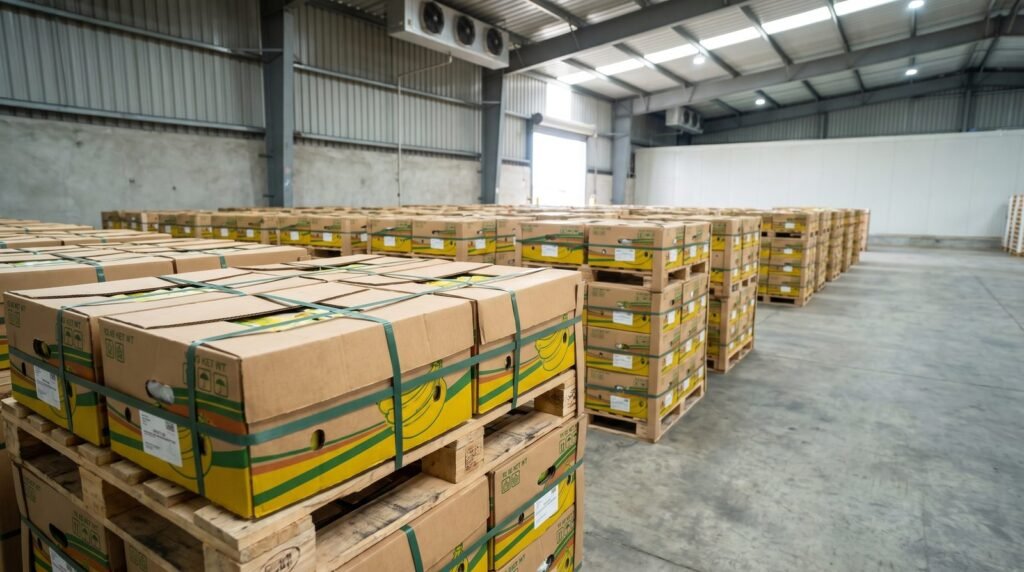
Dragon Hub packs Cavendish bananas to a written specification, holds the carton weight and pack size the buyer asks for, and supplies the document set an importer needs to file a declaration without a second round of emails. For a market that buys on reliability of supply rather than on a single low quotation, that is the part worth testing first. Send your spec and target volume through our products pages.
Frequently asked questions
What percentage of its food does Singapore import?
More than 90 per cent, according to the Singapore Food Agency, which repeats the figure in its March 2026 factsheet on food supply resilience. It is the share of the overall food supply rather than of any one category, and it has held at that level for years.
Is Singapore still working to the 30 by 30 goal?
No. The 2019 goal of producing 30 per cent of nutritional needs locally by 2030 was replaced on 4 November 2025. Under Singapore Food Story 2 the targets are 20 per cent of fibre and 30 per cent of protein produced locally by 2035.
How many countries supply food to Singapore?
187 countries and regions in 2024, up from around 140 two decades earlier, with the 2025 release citing over 180. The number is a measure of resilience rather than of volume — most tonnage still arrives from a small group of nearby suppliers.
Does Singapore grow its own fruit?
Only marginally, and fruit is not inside either 2035 production target. Those cover leafy and fruited vegetables, bean sprouts and mushrooms on the fibre side, and eggs and seafood on the protein side. Fruit therefore remains an almost entirely imported category.
Sources
- Singapore Food Agency factsheet, March 2026 — the more than 90 per cent import figure
- Singapore Food Statistics 2025 and 2024 — source counts, local fibre and protein shares, farm productivity
- Announcement of the 2035 targets, 4 November 2025 — the replacement of 30 by 30 under Singapore Food Story 2
- Singapore banana imports by partner, 2023 — total value and origin shares
