
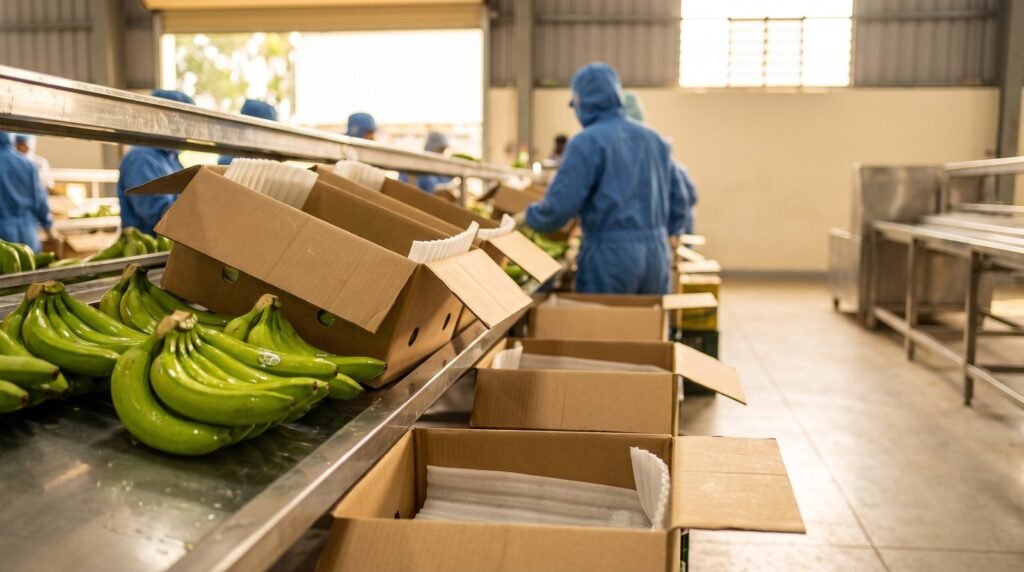
Vietnam is already Singapore’s third-largest source of bananas, at 7.88 per cent of import value in 2023. Malaysia is second at 21 per cent, and Vietnam supplied 61 per cent of Malaysia’s own banana imports in the same year. Framed as a search query the question reads: buying bananas direct from Vietnam vs through intermediary.
This is about what actually changes when the layer is there and when it is not. It is not an argument that one route is wrong. Both are normal, and a buyer can be well served either way — but not by accident.
Buying bananas direct from Vietnam vs through intermediary: where the fruit already is
Two import tables set up the question. In 2023 Singapore bought 55 per cent of its bananas by value from the Philippines, 21 per cent from Malaysia and 7.88 per cent from Vietnam. In the same year Malaysia bought 61 per cent of its bananas by value from Vietnam, ahead of the Philippines at 21 per cent.
Put those side by side and an inference suggests itself: some Vietnamese fruit probably reaches Singapore with a step in between. Be clear about what that is. It is an inference drawn from two separate import tables, not a re-export figure, because neither table follows fruit across a second border. Treat it as a reason to ask where the fruit was grown, not as a measured volume.
The background to both tables is covered elsewhere on this site: what the Singapore market buys and from whom in our note on supplying bananas to Singapore, and the reasons a banana-growing country imports bananas in why Malaysia imports bananas.
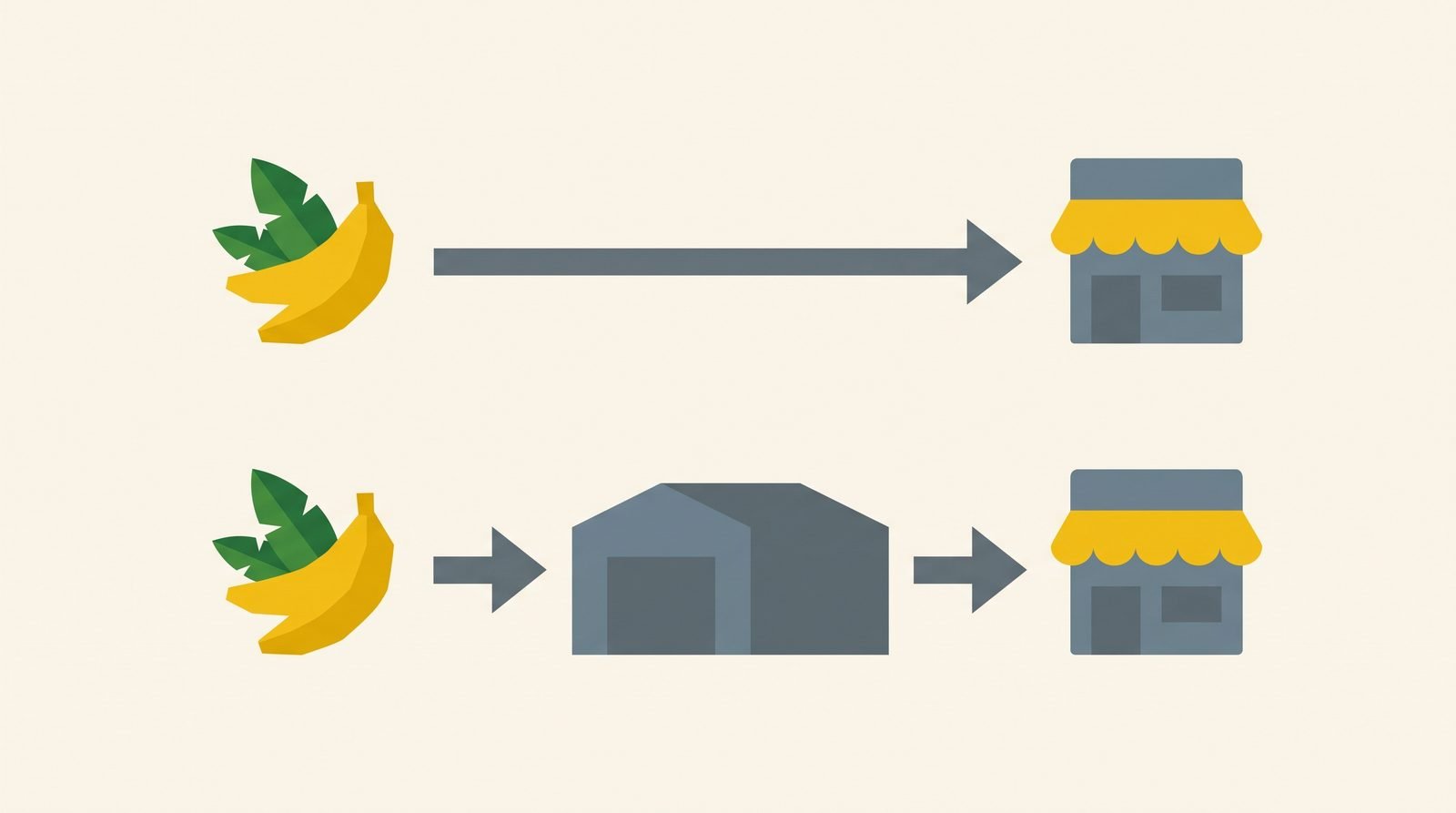
What the intermediary is doing
Before weighing the cost of the layer it is worth being precise about the work it does, because three of the four items are things a packhouse genuinely cannot do.
- Consolidation. Small and mid-sized buyers rarely want a full container of one line. Someone has to aggregate, and origin exporters sell containers.
- Credit and arrival risk. An importer buying on their own account carries the cash and the risk of a consignment that arrives wrong. A buyer paying on arrival has bought that service, whether or not it appears on the invoice.
- One counterparty. One invoice, one language, one phone number, one document set already in the format your border expects.
- Buffer stock. A warehouse near your stores can cover a missed sailing in a way a packhouse a thousand kilometres away cannot.
None of that is free and none of it is padding. If those are the things your business needs, the margin is buying something real.
What the layer changes
The cost is not only the margin. Three structural things change, and they are the ones buyers tend to notice late.
- Distance from the specification. The person who settles finger length, cutting maturity and carton weight is usually whoever talks to the packhouse. If that is not you, your specification arrives there as a preference rather than an instruction.
- Shorter answers on traceability. Country of origin survives a step in the chain. The growing area and the packing facility often do not, and those are what you need when a defect has to be traced.
- A slower feedback loop. A problem found in your ripening room has to travel back through the chain before it reaches the person who could change the cut. By then more containers have sailed.
Against that, going direct hands you the work the layer was absorbing: consolidation, documentation and the cash.
There is also a quieter effect on price visibility. Through a layer you see one delivered number, which bundles fruit, freight, clearance, finance and margin into a single figure that is hard to argue with line by line. Buying direct separates those costs, which is uncomfortable the first time and useful every time after.
The specification is the real question
In practice the direct-or-not question resolves into a narrower one. Who writes the specification, and who is accountable when a container misses it?
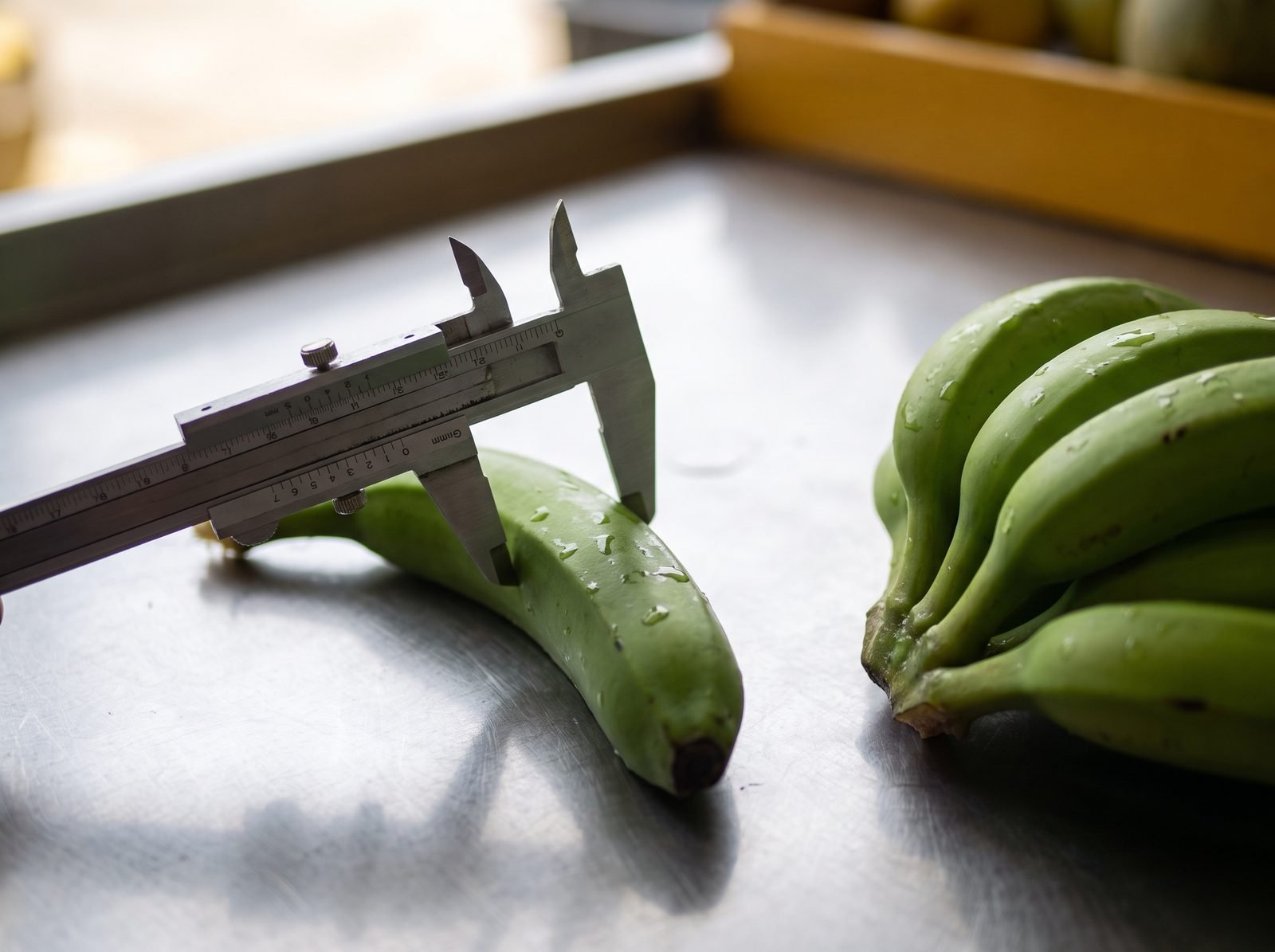
A buyer who goes direct without writing a measurable specification has taken the risk without taking the control, which is the worst of the two worlds. A buyer who stays with an importer but insists on a written specification with named tolerances and an inspection point has most of the control without the work. Our checklist for importing bananas from Vietnam lists what that document has to settle before anything ships.
When direct tends to be worth it
- You take at least one full container of one line at a predictable interval
- Your programme is specification-led, such as a retail line with named tolerances
- You have, or can hire, clearance and documentation capability at your end
- You can carry payment terms closer to shipment than to arrival
When the layer is the better answer
- Mixed pallets, several lines, or part-container volumes
- Payment on arrival matters more to you than unit price
- The programme is short or seasonal and not worth building origin relationships for
- You need buffer stock near the stores rather than at origin
A low-risk way to find out
Run one container direct alongside your existing supply rather than switching. One container answers what you actually want to know: whether the specification you wrote can be held, how the documents behave at your border, and how the fruit arrives when the cut was agreed with you rather than for you.
Keep the comparison honest by holding the specification identical on both sides, including carton weight and delivery colour stage. Two containers cut to different maturities tell you nothing about the route.
Record four things on the trial container and the comparison answers itself: the percentage of cartons outside specification at your inspection point, pulp temperature at the door, how many days of usable life the fruit had left, and how long a written query took to reach someone who could act on it. The last one is the number that most often decides the question.
Working with Dragon Hub
Dragon Hub packs and exports Cavendish bananas from Vietnam to supermarket and wholesale buyers across Asia and the Middle East, and is equally used to being one line inside a larger mixed programme. If you want to compare a direct cut against what you buy today, send the specification you already work to and we will answer it field by field. Our product range sets out what we pack.
Frequently asked questions
Is it cheaper to buy bananas direct from Vietnam?
The unit price is usually lower, because a margin and a handling step come out of the chain. Whether landed cost is lower depends on what you now do yourself: clearance, documentation, payment terms and the risk of an arrival you cannot refuse. Compare landed cost per kilo, not an origin price against a delivered one.
Does Vietnam already supply Singapore’s banana market?
Yes, directly. Vietnam was Singapore’s third-largest source of bananas by import value in 2023, behind the Philippines and Malaysia. Separately, Vietnam supplied the majority of Malaysia’s banana imports that year, which is why some Vietnamese fruit may also arrive in Singapore through another market.
What do I give up by going direct?
Consolidation, credit and a single counterparty. A packhouse sells containers rather than mixed pallets, and usually wants terms closer to shipment than to arrival. If your volumes are small or your working capital is tight, those are real services rather than overhead.
How do I keep quality consistent either way?
Write the specification down with measurable tolerances and a named inspection point, then make sure it reaches the packing facility rather than stopping at the desk in front of it. The document, not the number of parties in the chain, is what decides what comes out of the container.
Sources
- Singapore imports of bananas, HS 0803: supplier shares by value, 2023
- Malaysia imports of bananas, HS 0803: supplier shares by value, 2023
