
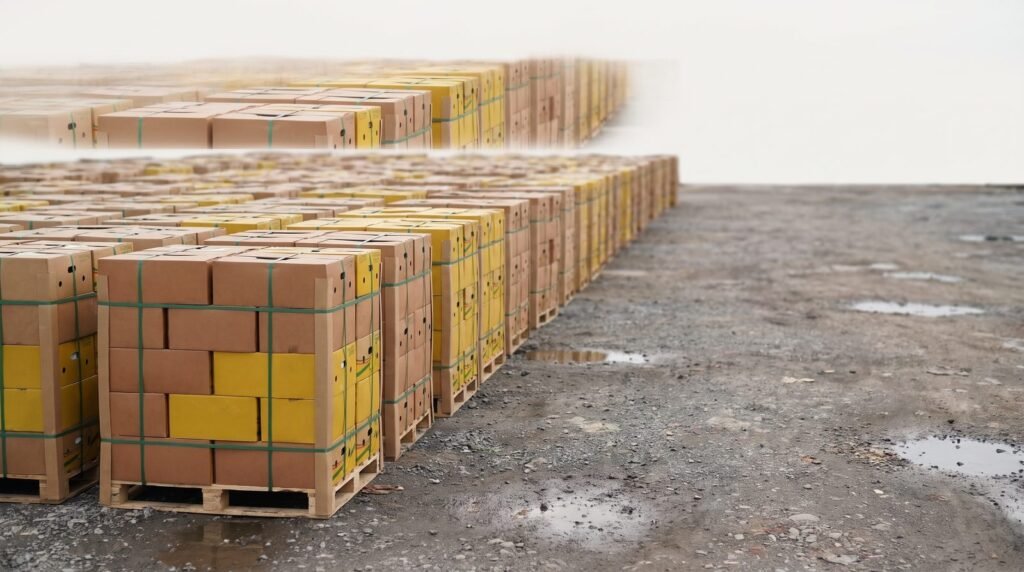
The gulf banana supply shift 2024 set in motion is easy to state and uncomfortable to read: more fruit arrived and the market paid less for it. On partner-declared data, banana volumes into the United Arab Emirates rose about 18 per cent that year while the value of the trade fell about 9 per cent.
Two years on we can say something the 2024 figures alone could not. The price reset was not a one-year dip. It held through 2025, with volume still climbing. For any supplier thinking about entering the Gulf on price, that is the single most important fact on the page.
What the gulf banana supply shift 2024 began looks like now
The series below is what exporting countries declared they shipped to the UAE under HS 080300, taken from WITS over UN Comtrade. Unit values are value divided by quantity, calculated by us.
| Year | Volume (tonnes) | Value (US$ million) | Unit value (US$/kg) |
|---|---|---|---|
| 2023 | 214,268 | 151.6 | 0.708 |
| 2024 | 252,739 | 137.6 | 0.544 |
| 2025 | 264,991 | 143.8 | 0.543 |
Across the two years volume rose 23.7 per cent, value fell 5.2 per cent and the average unit value fell 23.3 per cent. The 2025 figure is the one that settles the argument: at 0.543 dollars a kilogram against 0.544 the year before, the new level is not a correction waiting to be unwound. It is the level.
Ecuador absorbed most of the fall
The headline average hides which origin actually gave up the margin. Ecuadorean fruit went from 0.834 dollars a kilogram in 2023 to 0.572 in 2024 and 0.538 in 2025 — a drop of about 35 per cent — while its volume into the UAE grew from 100,144 to 136,718 tonnes. It sold 37 per cent more and earned less per kilo for all of it.
India moved differently: 0.570, then 0.490, then 0.525, on volume up from 84,063 to 92,153 tonnes. Philippine fruit grew fastest in volume, 19,095 to 28,526 tonnes, and gave up price to do it, 0.602 down to 0.498. By 2025 the three sat within four cents of each other and held 97 per cent of reported volume.

Where the extra fruit is coming from, and going
Part of the answer is global. World banana exports excluding plantain rose about 6 per cent in 2025 to more than 20.8 million tonnes, with Philippine shipments alone up 26 per cent to around 2.92 million tonnes, according to FAO figures reported in the trade press. A supply year like that has to land somewhere, and the Gulf is an open, duty-light, hard-currency destination.
Part of it is that the UAE is not only consuming this fruit. Excluding dates, the UAE re-exports roughly 600,000 to one million tonnes of fresh produce a year to its neighbours, and at least 300,000 tonnes of Saudi Arabia’s fresh produce imports arrive that way, on 2022 figures from Fruit and Vegetable Facts. Import volume into Jebel Ali is therefore partly regional distribution, which is why it can grow faster than the population it sits in. The practical consequences for a first shipment are in our guide to importing bananas to the UAE and the Gulf.
Two things this data cannot carry
The 2023 row is missing declared quantities for three small reporters, including Vietnam, so the 2023 unit value is slightly overstated and the 23 per cent fall should be read as an upper bound. And 2025 has 27 reporting origins against 36 in 2024, so it may yet be revised upward; Guatemala, which declared 9,081 tonnes in 2024, does not appear in 2025 at all.
One correction worth making to a story circulating in sourcing notes: Guatemala did not appear from nowhere in 2024. The UAE’s own 2023 import return records 3,510 tonnes from Guatemala, so the right reading is roughly a 2.6-fold increase, not a new entrant.
What Dragon Hub takes from a market like this
A market with falling unit values and rising volume is one where the cheapest seat is already occupied by origins with shorter lanes and bigger programmes. Entering it by undercutting them is entering at the worst possible point, and the first bad arrival ends the relationship.
The defensible position is the one priced on consistency: a fixed grade and carton, pre-cooling before the doors close, and arrival condition that a receiver can plan a shelf programme around. Concentration cuts both ways, too — when three origins hold 97 per cent of supply, a disease or weather event at one of them moves the whole market, which is why TR4 and supply risk belongs in a sourcing review. Buyers who want to test us can send a specification and we will answer it against what we pack, set out in our product range.
Frequently asked questions
Did banana prices in the Gulf really fall in 2024?
Import unit values did. On partner-declared data, bananas entering the UAE averaged 0.708 US dollars a kilogram in 2023 and 0.544 in 2024, a fall of about 23 per cent, while volume rose 18 per cent. Retail prices are set further down the chain and did not move in step.
Has the 2024 price level recovered since?
No. The 2025 average was 0.543 dollars a kilogram, effectively unchanged from 0.544, on volume up another 4.8 per cent. Two years at the same level is better treated as the market’s new baseline than as a dip.
Why is UAE banana import volume growing so fast?
Two reasons. Global supply grew about 6 per cent in 2025, which has to find buyers; and a large share of fruit landing in the UAE is re-exported to neighbouring Gulf markets rather than eaten locally, so the import figure measures regional distribution as well as domestic demand.
Sources
- WITS over UN Comtrade, HS 080300 exports to the United Arab Emirates, 2023 to 2025 — volumes and values by origin and year; totals, percentage changes and unit values calculated by us
- WITS over UN Comtrade, UAE imports of HS 080300, 2023 — the UAE’s own return, including 3,510 tonnes from Guatemala
- FreshPlaza, 2 February 2026, on FAO data — world banana exports up 6 per cent in 2025 to over 20.8 million tonnes and Philippine shipments up 26 per cent
- Fruit and Vegetable Facts via FreshPlaza, 28 May 2024 — UAE re-export volumes of fresh produce and the share reaching Saudi Arabia, on 2022 figures
