
Two unrelated things get called a residue problem when a reefer is held in Dubai. One is chemistry: a laboratory result against a legal limit. The other is biology: a live organism on the fruit. They sit with different authorities, are proved by different documents, and fail in different ways — and the UAE pesticide MRL fresh produce has to clear changed at the end of 2024, which much of the trade guidance online has not caught up with.
This is the mechanism rather than a table of numbers. Quoting a limit for a specific active from a blog post is how a spray programme gets built against the wrong figure, so the limits here are pointed at, not reproduced.
Which UAE pesticide MRL fresh produce is measured against now
The governing instrument is Cabinet Resolution No. 116 of 2024, on the Technical Regulations for Maximum Residue Limits for Pesticides in Agricultural and Food Products. It was issued on 22 October 2024, published in Official Gazette No. 786 on 31 October 2024, and took effect the day after publication.
Three things in it matter commercially. It makes UAE.S MRL 1:2024 mandatory in the UAE. It repeals UAE.S MRL 1:2019, approved under Cabinet Resolution No. 4 of 2020. And it gave the concerned authorities 180 days to align.
So a specification sheet, a laboratory quotation or a buyer’s checklist that still cites MRL 1:2019 is citing a repealed regulation. The current federal report on UAE requirements lists the 2024 edition, published in December 2024, as the standard in force, and points to a published database of approved pesticides and their limits as the place to check an active.
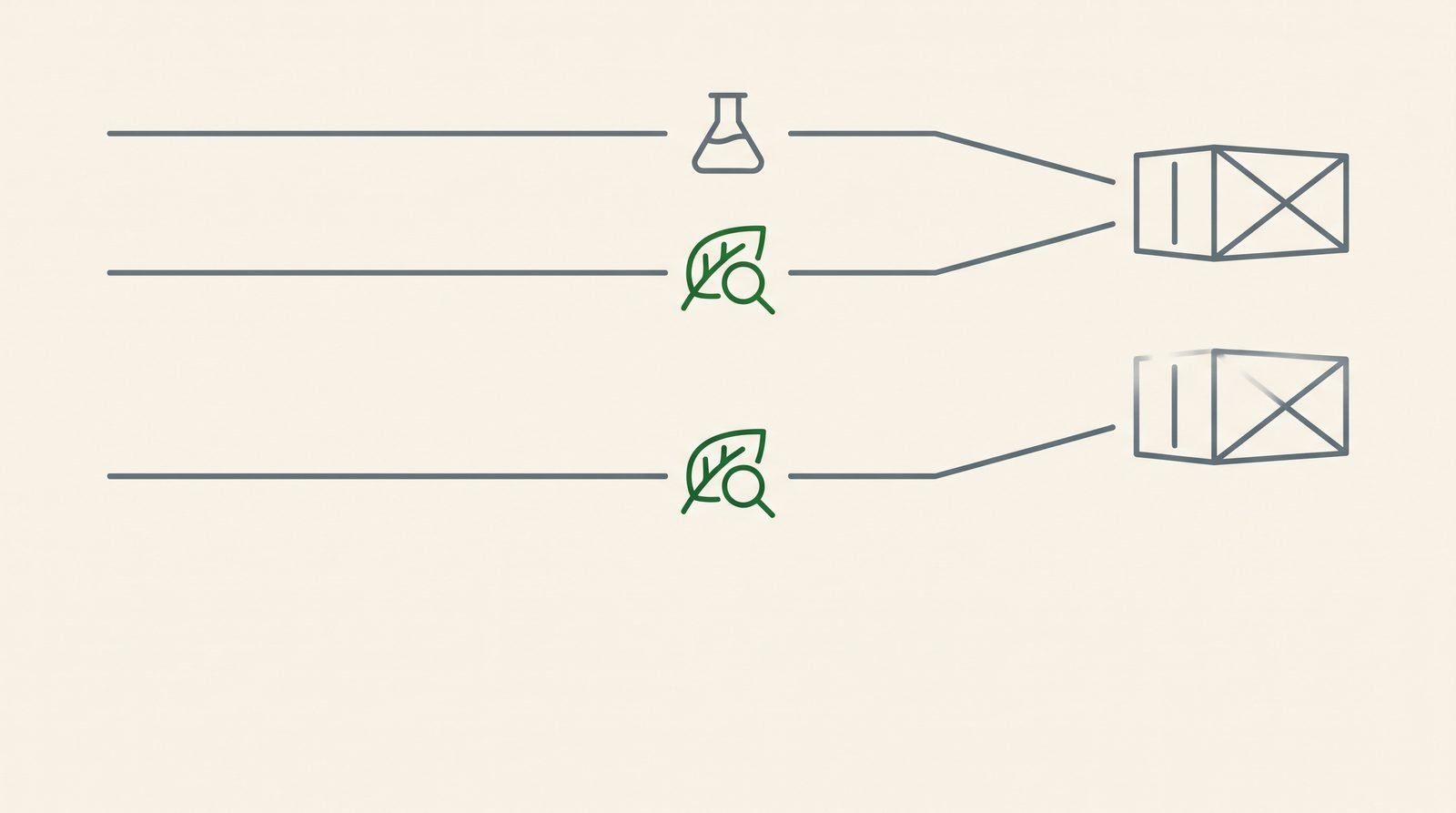
The UAE pesticide MRL fresh produce must satisfy is a chemistry question, enforced through sampling and laboratory testing by the municipality at the port. A clean result proves nothing about pests.
The pest side is federal. The Ministry of Climate Change and Environment runs plant quarantine, and its Decree 824:2015 lists the quarantine pests prohibited in the UAE together with non-quarantine pests tolerated under conditions. That risk is addressed by the phytosanitary certificate and any additional declaration the destination sets for the origin, not by a residue report.
Buyers routinely ask for “test results” meaning one and receive the other. Naming which of the two you want removes a round of email and a week of calendar.
What the port sampling record looks like
A study published in Heliyon in 2022 analysed 4,513 samples of imported fresh fruit collected at Dubai ports between 2018 and 2020, screened by GC-MS/MS and LC-MS/MS. It identified 81 different pesticide residues, and 26.8 per cent of samples sat above the limits used as the benchmark. The residues found most often were chlorpyrifos, carbendazim, cypermethrin and azoxystrobin, each in more than 150 samples.
Two scope caveats, because they change what the figure means. The benchmark in that study was the European Union’s maximum residue limits, not the UAE’s own standard, so the percentage is not a UAE violation rate. And the sampling predates MRL 1:2024 entirely.
What the data does support is a sense of where attention goes. The highest shares of samples carrying multiple residues above the limit were in longan, at 81.4 per cent, and rambutan, at 66.7 per cent. Bananas were not among the commodities the study flagged — which is useful context for a buyer, and not a clearance for any individual consignment.
When there is no UAE figure for your crop
Published accounts differ on what applies in the gap, and the difference is worth knowing before relying on either. The federal report describes a fallback order of Codex first, then the EU, then the United States — but describes it for rice specifically, in the context of a new annex, rather than as a general rule. A long-standing horticultural export manual says more simply that the UAE defers to Codex, with EU limits as the next reference.
Codex first is the common ground. Everything after that is an assumption. Ask the importer to obtain, in writing, which reference the testing laboratory will apply to the commodity in question — an email before the season, instead of an argument with the container on the quay.
Build the panel from the spray record
The expensive failure in practice is not a dirty sample. It is a clean certificate that tested the wrong analytes: a standard multi-residue screen that never looked for the actives actually used in that growing area in that season.
The sequence that avoids it runs in one direction. Start from the application record for the growing area, list the actives used and their last application dates, check each against the published limits and the approved list, and only then choose the screening scope with the laboratory. A panel chosen from a price list produces a document that reads as compliant and proves nothing.
What happens when a sample is drawn
Products registering for the first time undergo laboratory testing through Dubai Municipality, with the decision based on the product’s safety risk and how often it is imported, and shipments may also be inspected on arrival. Samples go to the Food and Environment section of the Dubai Central Laboratory, and results can take up to five working days depending on the test.
Five working days is the figure to plan around, because the fruit ages on power while the result is outstanding. What the container can absorb is a green life question rather than a laboratory one, and the arithmetic is in our note on banana green life in days. If a consignment is held, the condition it arrives in is assessed separately again — see banana quality inspection on arrival.
How Dragon Hub handles residue testing
Dragon Hub packs and exports Cavendish bananas, and residue scope is set per destination rather than by reusing one certificate across markets. Send us the commodity, the port of entry and the reference your laboratory applies, and the screening panel is built from the growing area’s application record against that reference. Specifications and pack formats are on the product range page.
Frequently asked questions
Which residue standard applies to fruit entering the UAE?
UAE.S MRL 1:2024, made mandatory by Cabinet Resolution No. 116 of 2024 with effect from the start of November 2024. It replaced the 2019 regulation, which was repealed by the same resolution. Any specification still naming MRL 1:2019 should be updated before it is used to set a spray programme.
Does a phytosanitary certificate cover pesticide residues?
No. The phytosanitary certificate addresses quarantine pests and plant health, which is the federal ministry’s remit. Residue limits are a separate regime proved by laboratory analysis, sampled by the municipality at the port. A consignment can pass on one and fail on the other, so both are specified separately.
What if no UAE limit exists for the active we use?
Published guidance points to Codex as the first reference, and differs beyond that. Rather than assuming the next step, have the importer confirm in writing which reference the testing laboratory will apply to that commodity. Obtain that answer before the spray programme is set, not after a sample has been drawn.
Sources
- Cabinet Resolution No. 116 of 2024 on the Technical Regulations for Maximum Residue Limits for Pesticides in Agricultural and Food Products — issue date of 22 October 2024, Official Gazette No. 786 of 31 October 2024, entry into force, the mandatory application of UAE.S MRL 1:2024, the repeal of UAE.S MRL 1:2019 approved under Cabinet Resolution No. 4 of 2020, and the 180-day alignment period.
- USDA FAIRS Country Report Annual, Dubai, United Arab Emirates, November 2025 — the 2024 residue standard published in December 2024, the pesticide limits database, the Codex and EU fallback order described for rice, MoCCAE Decree 824:2015, first-time registration testing, the Dubai Central Laboratory, and results of up to five working days.
- Pesticide residues in fresh fruits imported into the United Arab Emirates, Heliyon, 2022 — 4,513 imported fresh fruit samples at Dubai ports from 2018 to 2020, 81 residues identified, 26.8 per cent above the EU limits used as the benchmark, the four most frequently detected actives, and the longan and rambutan figures.
- Northwest Horticultural Council export manual, United Arab Emirates — the account of the UAE deferring to Codex with EU limits as the next reference.
