
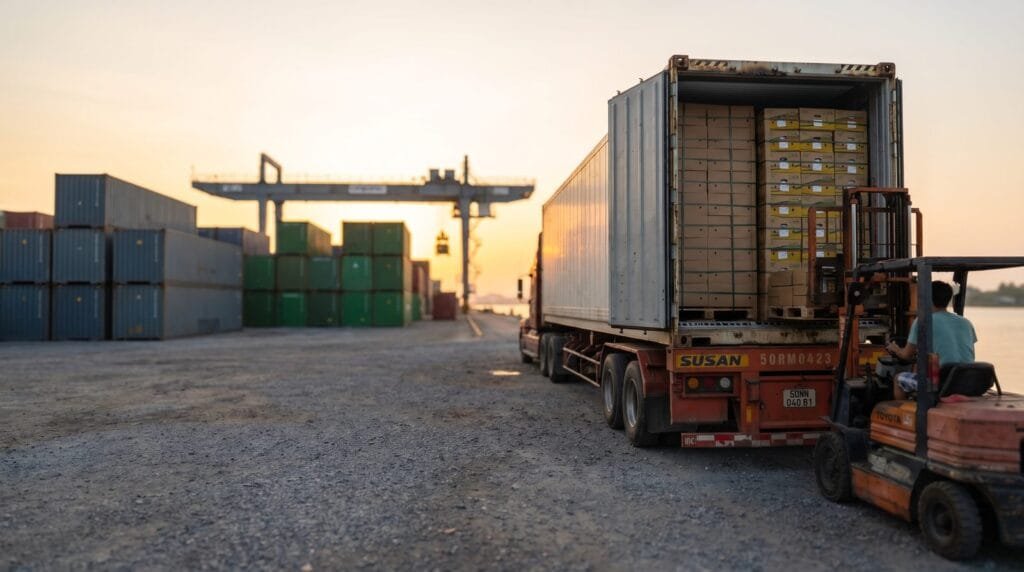
Ho Chi Minh to Port Klang is about two to three days at sea. That single number changes how a banana programme on this lane should be planned, because it moves the hard part off the water and onto the land at both ends.
Most cold-chain advice is written for voyages of three or four weeks. Almost none of it applies here.
Ho Chi Minh to Port Klang: the sea leg is the easy part
Sailings between the two ports run frequently and transit is quoted at roughly two days and change. Set that against the published green life potential for mature-green Cavendish — two to four weeks in air — and the arithmetic is almost embarrassing. The voyage consumes a small fraction of the fruit’s remaining life.
Compare it with an origin shipping from South America into the same port, where the vessel alone eats most of the available window. On that lane everything must be cut lean and everything must run on time. On this one, neither is true.
Which means the constraint moves onshore
When the sea leg is short, the days that decide outcomes are the ones before the container is sealed and after it is discharged.
- Field heat. The first day after cutting costs more green life than the entire voyage. A 24-hour delay before cooling has been measured to cost about six days of green life — roughly three voyages’ worth on this route.
- Port and clearance time. A consignment held for inspection, or waiting on a permit condition nobody passed upstream, spends real days in a lane where the shipping only spends two.
- The inland leg and the ripening room. Whatever happens after discharge is now a larger share of the total than the ocean freight is.
So the useful question to a supplier on this lane is not “how long is the voyage” but “how many hours between cutting and cold”.
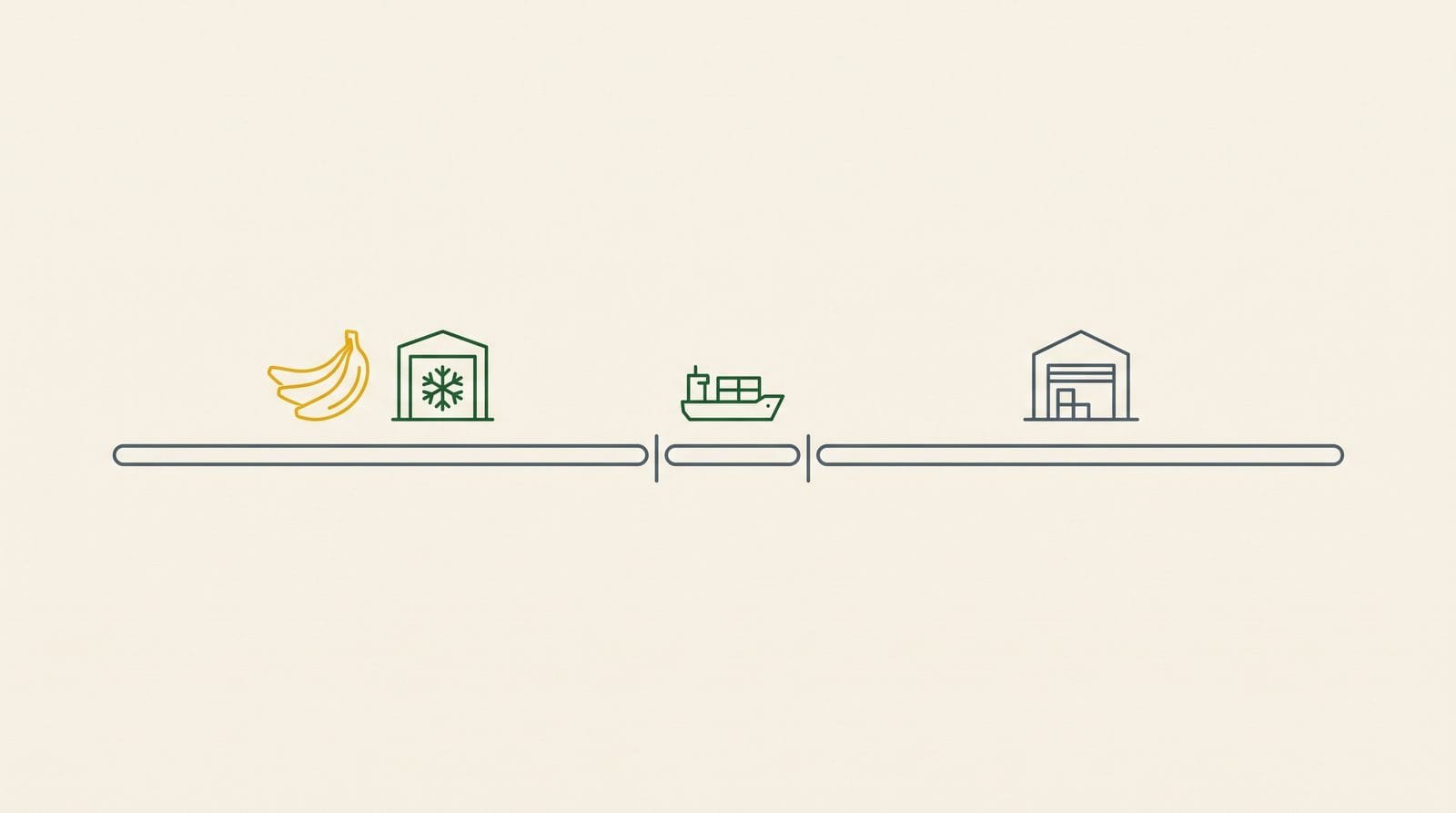
Frequency changes the shape of the programme
A short lane with frequent departures allows something a long lane cannot: smaller, more frequent shipments. On a three-week route the economics push you toward large consignments spaced far apart, because each one carries weeks of risk and working capital. Here you can run a tighter rhythm.
That has three practical effects. Fruit on the shelf is younger, because less of its life was spent getting there. Inventory risk per shipment is smaller, so a single bad container is a smaller event. And a specification problem is caught within days rather than discovered three weeks later on a container that has already been followed by two more.
The trade-off is handling cost per kilo and more frequent administration. Whether the rhythm is worth it depends on your storage and your turnover, but it is a choice this lane offers and most do not.
Ask whether the service is direct
One caution on the transit figure. A quoted two-day transit can be a direct service or it can involve transhipment, and the two behave differently when something slips. A direct box is on one vessel. A transhipped box is lifted off, waits on a quay, and is lifted on again — and the waiting is done by a reefer that needs to stay plugged in.
On a lane this short a single missed connection can double the transit. Ask your forwarder whether the service is direct, and if it is not, ask who is responsible for keeping the container powered at the transhipment port. It is an unglamorous question that prevents an expensive surprise.
What to do with the margin
A short lane hands you spare green life, and it can be spent two ways. A supplier who does not ask which you want is not really planning your programme.
- Cut fuller. Fuller fruit eats better after ripening. On a three-week lane it is too risky; on a two-day lane it is available, and it is the quality advantage proximity actually buys.
- Keep it as insurance. Hold the maturity leaner and bank the days against a missed sailing, a port delay or an inspection. Useful if your receiving end is tight or your clearance is unpredictable.
What you should not do is accept the same cutting maturity a supplier quotes for a Gulf or European programme. The routes are not comparable and the cut should not be identical.
The regime still has to hold
A short voyage forgives late arrival. It does not forgive wrong temperature. Chilling injury is a matter of dose and time rather than a cliff — an hour at 10 °C is enough to cause moderate injury in mature-green fruit, and damaged fruit will not ripen properly afterwards no matter how quickly it got there.
The regime, the reasons behind each figure and the stowage that makes them work are in our note on reefer container settings for bananas. The short version for this lane: correct setpoint, unobstructed airflow, and a container that stays plugged in through any inspection.
Planning a lane like this
- Give the supplier total days from packhouse to ripening room, not port-to-port transit
- Agree the cutting maturity explicitly, and say whether you want fullness or insurance
- Ask how many hours pass between cutting and the cold room — the answer matters more than the sailing schedule
- Fix carton weight and stow pattern before comparing quotations
- Make sure the reefer stays powered during port inspection
Working with Dragon Hub
Dragon Hub packs and exports Cavendish bananas to supermarket and wholesale buyers across Asia and the Middle East, Malaysia included. On a short lane we would rather discuss cutting maturity than freight rates, because that is where the quality on this route is actually decided. The full specification is on the Cavendish banana page, alongside the rest of our product range.
Frequently asked questions
How long does shipping take from Ho Chi Minh to Port Klang?
Roughly two to three days at sea, with frequent sailings between the two ports. For bananas that is a small fraction of the fruit’s green life, which is why the planning constraint on this lane sits in harvest timing and clearance rather than in the voyage itself.
Does a short voyage mean I can buy riper fruit?
It means fuller fruit becomes possible, which eats better after ripening. Whether to take the margin as fullness or keep it as insurance against delays is a commercial decision, and it should be agreed before harvest rather than assumed by either side.
What matters most on a short banana lane?
The hours between cutting and cooling. A 24-hour delay before the fruit reaches the cold room has been measured to cost about six days of green life, which on a two-day voyage is several times the transit itself. Field heat, not sea time, is the risk here.
Can a short voyage compensate for a wrong temperature setting?
No. Chilling injury depends on dose and time, and an hour at 10 degrees Celsius is enough to cause moderate injury in mature-green fruit. Damaged fruit will not ripen properly afterwards regardless of how quickly it arrived, and the failure shows in the ripening room rather than at the door.
Sources
- Port Klang to Cat Lai transit profile: quoted transit time and sailing frequency between the two ports
- UC Davis Postharvest — Banana: green life potential and the chilling injury dose and time relationship
- ISHS — cooling delays and green life: measured green life loss after a 24 hour delay before cooling
