
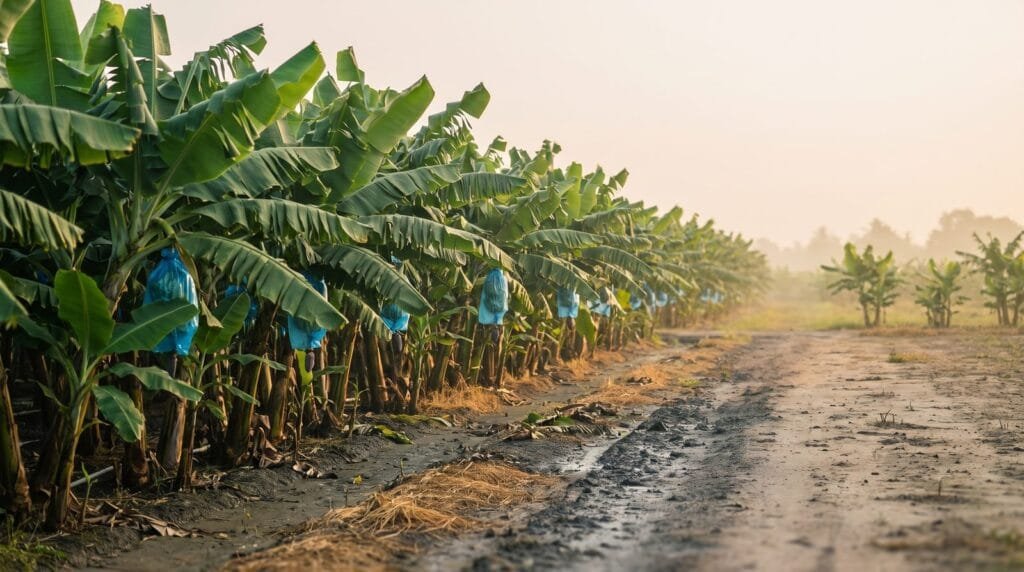
Malaysia grows bananas. It grows them across the peninsula, harvests them all year, and its banana self-sufficiency ratio ran at 100.1 % between 2016 and 2020. So why does Malaysia import bananas at all — about 30.6 million kilograms of them in 2024?
The answer is in the direction of travel, not the ratio.
Why Malaysia imports bananas: the domestic base is contracting
| 2017 | Latest reported | |
|---|---|---|
| National production | 350,493 t | 312,968 t (2020) |
| Planted area | 34,894 ha | 26,079 ha (2019) |
Production fell by about 11 % over three years. Planted area fell by about a quarter in two. A self-sufficiency ratio describes a balance at a moment; it does not tell you which way the balance is moving, and here it is moving one way.
Johor alone accounts for roughly 32 % of what remains, which is a concentration worth noticing: a national supply leaning heavily on one state is a supply with a single point of failure.
What is removing the area
The main cultivars planted in Malaysia are Berangan and Cavendish, and more than half of that planted area is highly susceptible to Fusarium wilt.
Soil-borne Fusarium wilt does not cause a bad season. Spores persist in the ground for decades, infected land cannot be cleaned and replanted with a susceptible cultivar, and losses on an affected block run toward total. Area does not dip and recover; it leaves.
That is the mechanism behind the two rows in the table above, and it is why the trend is more informative than the ratio.
Self-sufficient in bananas is not self-sufficient in Cavendish
There is a second reason the ratio misleads, and it is a matter of which banana. A self-sufficiency figure counts bananas as one commodity. The market does not.
What Malaysia grows most of is local dessert fruit — Berangan and pisang emas, the aromatic varieties people buy to eat fresh. What crosses the border is almost entirely Cavendish: graded by finger length, packed to a standard carton, ripened to a chosen colour stage for a supermarket programme. The two are not interchangeable in a retail listing, and a buyer cannot substitute one for the other because a national ratio says the country has enough bananas.
So the honest reading of 100.1 % is narrower than it looks: enough bananas in total, from a contracting base, of largely the wrong type for a graded import programme.
What that means for a buyer
Imports here are not covering a gap that opened once and will close again. They are covering a base that keeps moving, which changes what a Malaysian buyer should value in a supplier.
- Continuity is worth more than the last cent. A supplier who can hold volume through a year matters more when the domestic alternative is shrinking.
- Ask where the fruit comes from, not just who sells it. Two suppliers drawing on the same district is one exposure with two names — and the disease that is removing Malaysian area is present across the region.
- Contract ahead rather than buying spot. Spot buying works while supply is comfortable and stops working exactly when you need it to work.
Where the imports come from
Overwhelmingly Vietnam, which supplied 70.4 % of Malaysian banana import volume in 2024 — 21.6 million kilograms of the 30.6 million total. The Philippines followed at 12.8 %, Indonesia at 9.2 % and Thailand at 6.5 %.
Proximity is most of the reason. A short sea leg spends little green life, which is the days a banana stays green after cutting, and that margin is what lets fruit be cut fuller and still arrive in condition. Which is the short answer to why Malaysia imports bananas at all: a domestic base that is shrinking, and a reliable source of graded Cavendish close enough to reach in days.
Working with Dragon Hub
Dragon Hub packs and exports Cavendish bananas to supermarket and wholesale buyers across Asia and the Middle East, Malaysia included, quoting against a written specification rather than a market average. The full specification is on the Cavendish banana page, alongside the rest of our product range.
Frequently asked questions
Is Malaysia self-sufficient in bananas?
On paper, yes: the self-sufficiency ratio was 100.1 % between 2016 and 2020. But production fell from 350,493 tonnes in 2017 to 312,968 by 2020 and planted area from 34,894 hectares to 26,079 in two years, so the balance is being held while the base contracts.
Why is Malaysian banana area shrinking?
Mainly Fusarium wilt. More than half the planted area is under cultivars highly susceptible to it, and the disease is soil-borne, persists for decades and makes infected land unusable for susceptible varieties. Affected area is lost rather than reduced.
How much banana does Malaysia import?
About 30.6 million kilograms in 2024, worth roughly 15.3 million US dollars. Vietnam supplied 70.4 % of that volume, ahead of the Philippines at 12.8 %, Indonesia at 9.2 % and Thailand at 6.5 %.
Sources
- FAMA Malaysia: production and planted area, self-sufficiency ratio, Johor share, cultivars and Fusarium susceptibility
- Malaysia fresh banana market overview: import volume and value, origin shares 2024
